Friday, July 21, 2006
Real Life Talk Show Episode
I remember seeing an episode of the Maury Povich show a couple years ago, I think the title of the show was something like "I am deathly affraid of balloons and its ruining my life!" On the show Maury brought out these people who were affraid of balloons, snakes, spiders, clowns, hair and kittens, talked to them about their phobia, brought out whatever it was that they were affraid of and then chased after them with the camera and a microphone as they ran all over the studio to get away from what ever it was. I remember thinking, "ok, spiders, snakes, even clowns I can see, but they must have hired these people that say they're affraid of balloons, hair and kittens." Well, as for the kittens, I stand corrected. The other day I saw the smallest, cutest little kitten walking in the road crying, no mother cat in sight. I didn't want the cute little guy to become street pizza plus I have a couple friends who had mentioned they wanted a cat to keep mice, lizards and scorpions (a whole other story) out of their huts, so I picked her up and brought her home. This kitten is adorable, small enough to fit in the palm of one hand, but on her way back to my house we were able to make grown men and women run for their lives. All I had to do was hold her and bring her within 5 meters of one man and he started yelling, turned and fled. The little kids aren't any better, they start screaming and crying, one little girl nearly fell on her head trying to escape the beast. They are affraid that the cat will bite and scratch them, or at least thats what they say. I have to confess that she does bite me quite regularly when she mistakes my finger for something she can nurse, but it doesn't hurt. Now I'm starting to wonder if more stuff isn't the real thing on 'Springer' as well.

Sunday, July 16, 2006
Respecting elders part 2
There is a second part to this respecting elders tradition that is definitely much different from the family I grew up in. The hierarchy of the nuclear family and the behavior that results is something that might be found unusual to most outsiders.
I have two younger sisters, and here in Senegal, that would give me quite a bit of influence over them in that if I told them to do something, answer the phone, get me a drink of water, run to the store to get me something, they would have to do it, ideally without complaint. What actually happens with my sisters? If they are feeling kind, they’ll do it upon request, if they’re feeling somewhat kind they’ll begrudgingly do it, complaining a little, and if its an average day, they’ll tell me to get it myself.
My youngest host-sister, Maguette, is always fetching things for people, she has 4 older siblings, 2 parents and 1 grandparent that are always requesting stuff. She’s getting into her teenage years so her fetching is not always unaccompanied by bickering. So the higher up on the food chain you are, the less you have to do for yourself. Its still a little confusing with the gender differences because the oldest in the family is my host-sister Fatim and she does quite a bit of house work when she’s visiting from University in Dakar.
If anything is certain, it is that my host-dad is king of his castle, though he technically has to obey his mother. When he is home, he doesn’t lift a finger. My host-brothers open the gate for his car, set out his chair and the tv for him to watch the news and the thing that surprises me every time is that he will walk right past the phone when its ringing so that someone lower on the food chain will answer it. My host-mom serves him his dinner first out of everyone and if there is anything lacking in his service he will proceed to berate whoever is at fault. This berating, people tell me, is the Senegalese way of encouraging but that doesn’t stop me from feeling uncomfortable when he asks be if there is a medication to cure stupidity in the U.S.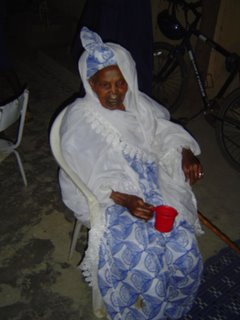
Also, I managed to find a picture of my host grandma so you can see her, it's a little fuzzy but you get the idea. This is Mariemme Welle, and this is actually what she does for much of the day. More recently she's been taking walks, very slowly to go visit her friends.
I have two younger sisters, and here in Senegal, that would give me quite a bit of influence over them in that if I told them to do something, answer the phone, get me a drink of water, run to the store to get me something, they would have to do it, ideally without complaint. What actually happens with my sisters? If they are feeling kind, they’ll do it upon request, if they’re feeling somewhat kind they’ll begrudgingly do it, complaining a little, and if its an average day, they’ll tell me to get it myself.
My youngest host-sister, Maguette, is always fetching things for people, she has 4 older siblings, 2 parents and 1 grandparent that are always requesting stuff. She’s getting into her teenage years so her fetching is not always unaccompanied by bickering. So the higher up on the food chain you are, the less you have to do for yourself. Its still a little confusing with the gender differences because the oldest in the family is my host-sister Fatim and she does quite a bit of house work when she’s visiting from University in Dakar.
If anything is certain, it is that my host-dad is king of his castle, though he technically has to obey his mother. When he is home, he doesn’t lift a finger. My host-brothers open the gate for his car, set out his chair and the tv for him to watch the news and the thing that surprises me every time is that he will walk right past the phone when its ringing so that someone lower on the food chain will answer it. My host-mom serves him his dinner first out of everyone and if there is anything lacking in his service he will proceed to berate whoever is at fault. This berating, people tell me, is the Senegalese way of encouraging but that doesn’t stop me from feeling uncomfortable when he asks be if there is a medication to cure stupidity in the U.S.
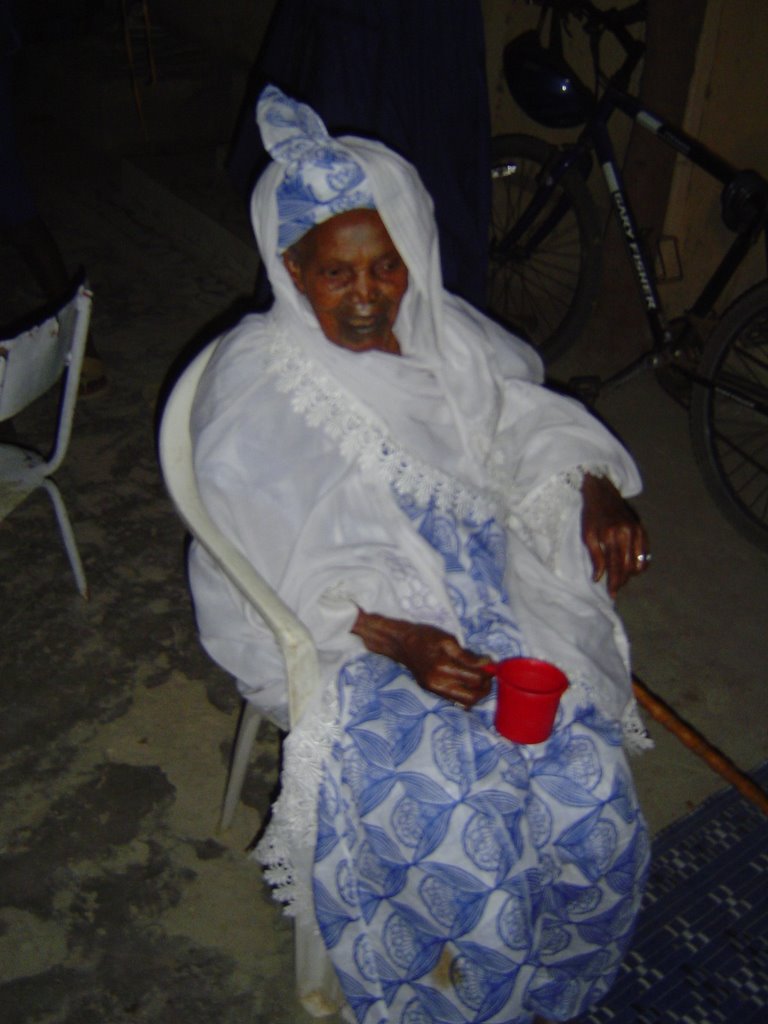
Also, I managed to find a picture of my host grandma so you can see her, it's a little fuzzy but you get the idea. This is Mariemme Welle, and this is actually what she does for much of the day. More recently she's been taking walks, very slowly to go visit her friends.
Tuesday, July 11, 2006
Respect for Elders
I wouldn’t say that I don’t have respect for elders. I will acknowledge right now that my grandparents have lived a lot longer than I have, have seen a lot more things, have lots more rich experiences and know a lot of things I don’t. I also love joking around with my grandparents, they love it when my sisters and I push the limits with our humor at the dinner table, but if they are wrong about something I’m going to let them know it.
Here, it just doesn’t happen like that. Elders are respected, you are not to talk back, debate or tell someone older than you that they are anything but perfect and right. I knew this but I got a little sloppy the other day and it came back to me. I have gotten in the habit of telling people they are rude. This is almost always in response to being called Tubab, Xonq a nop (red ears – a derogatory term for white person), or to someone who has told me that I don’t understand Wolof or French or any language for that matter (the Senegalese way of encouraging you).
At lunch the other day, my friend Sarah was over, Sarah studied in Dakar for a semester during college and therefore was way ahead the rest of our group when it came to Wolof. At lunch my host-grandma, who had been acting uncharacteristically obnoxious for a few days(I think because she had a guest), was speaking to Sarah and lapsed into Pulaar, her first language. When Sarah showed she didn’t understand host grandma says ‘Deggul Wolof, deggul Pulaar, deggul dara.’ Translated, ‘She doesn’t understand Wolof, she doesn’t understand Pulaar, she doesn’t understand anything.’ To which I respond, ‘Dem na université ci Dakar, degg na Wolof, yow, danga reew.’ Translated ‘She went to university in Dakar, she understands Wolof, and you, you’re rude.’ Nothing was said at the time but I heard later from my brother Guelaye that it’s not acceptable to talk to her like that.
This got me thinking. Could this cultural norm be standing in the way of development here? Of course it isn’t a huge factor, but if an elder tells you to do something a certain way, or not to do something, you must obey orders. How many elders are going to be telling young girls that they should join the football team or study instead of washing the clothes and preparing meals, how many elders are going to tell young boys to go study or read instead of helping in the fields. Since it seems to be pretty universal that older folks are more conservative than youth, I don’t think we are going to be seeing many grandparents encouraging kids to go above and beyond for education or encouraging girls to do things that aren’t within their traditional gender roles. I see more of an ‘I did it this way when I was your age, it’s good enough for you,’ mentality than anything else.
When I think about any sort of social advance or social revolution made in developed countries in the past couple hundred years, there was always some sort of disobedience involved, people saying ‘NO!’ to their elders and to the way their elders did things. I’m not saying it can’t happen here, but development will just be more difficult and slower with people adhering so strictly to the ‘Respect your elders’ norm.
Here, it just doesn’t happen like that. Elders are respected, you are not to talk back, debate or tell someone older than you that they are anything but perfect and right. I knew this but I got a little sloppy the other day and it came back to me. I have gotten in the habit of telling people they are rude. This is almost always in response to being called Tubab, Xonq a nop (red ears – a derogatory term for white person), or to someone who has told me that I don’t understand Wolof or French or any language for that matter (the Senegalese way of encouraging you).
At lunch the other day, my friend Sarah was over, Sarah studied in Dakar for a semester during college and therefore was way ahead the rest of our group when it came to Wolof. At lunch my host-grandma, who had been acting uncharacteristically obnoxious for a few days(I think because she had a guest), was speaking to Sarah and lapsed into Pulaar, her first language. When Sarah showed she didn’t understand host grandma says ‘Deggul Wolof, deggul Pulaar, deggul dara.’ Translated, ‘She doesn’t understand Wolof, she doesn’t understand Pulaar, she doesn’t understand anything.’ To which I respond, ‘Dem na université ci Dakar, degg na Wolof, yow, danga reew.’ Translated ‘She went to university in Dakar, she understands Wolof, and you, you’re rude.’ Nothing was said at the time but I heard later from my brother Guelaye that it’s not acceptable to talk to her like that.
This got me thinking. Could this cultural norm be standing in the way of development here? Of course it isn’t a huge factor, but if an elder tells you to do something a certain way, or not to do something, you must obey orders. How many elders are going to be telling young girls that they should join the football team or study instead of washing the clothes and preparing meals, how many elders are going to tell young boys to go study or read instead of helping in the fields. Since it seems to be pretty universal that older folks are more conservative than youth, I don’t think we are going to be seeing many grandparents encouraging kids to go above and beyond for education or encouraging girls to do things that aren’t within their traditional gender roles. I see more of an ‘I did it this way when I was your age, it’s good enough for you,’ mentality than anything else.
When I think about any sort of social advance or social revolution made in developed countries in the past couple hundred years, there was always some sort of disobedience involved, people saying ‘NO!’ to their elders and to the way their elders did things. I’m not saying it can’t happen here, but development will just be more difficult and slower with people adhering so strictly to the ‘Respect your elders’ norm.
Sunday, July 09, 2006
Then and Now Part 2
Because the first installment was such a hit here are some more changes I've noticed in myself since I moved to Senegal;
Then: Contacts pretty much every day
Now: Glasses pretty much every day because of dryness, sand, etc.
Then: Jewish community was large part of my life, working at Maccabi USA, Camp Shalom and active with the Hillel.
Now: I pretty much AM the Jewish community here. There are a few Jewish volunteers in country but we don’t do much together.
Then: Would relish listening to or watching BBC news whenever I got the chance.
Now: BBC is my main source of news, listening to it every morning and sometimes more often. The only English programming I’ve found on the old short-wave radio are BBC, Voice of America (no thanks!), and a crap-load of Christian programs that are homophobic, xenophobic, Islamophobic, and overall, not very pleasant to listen to.
Then: My life and surroundings were quite secular. I felt this way even though it seems like the separation of church and state is often in danger in today’s US.
Now: My life continues to be secular though my surroundings are anything but. Here, though it’s not an Islamic Republic like Mauritania, our neighbor to the north, 95% of the people I know here Muslim. People grow up praying 5 times per day, and just accepting Islam as their default, without question, so that is the way they live their lives.
Then: Washed and dried my clothes by machine
Now: My clothes are washed, by hand, by my family’s maid and I wash my unmentionables myself by hand, everything is dried on a line. I usually buy Marie (the maid) a little gift when she does my laundry. In the beginning washing clothes would leave my hands with sores from the rubbing but my hands are getting tougher now. This washing involves two basins of water and a bar of soap. One basin is used for washing and one for rinsing.
(Related)
Then: My socks got relatively clean, i.e. the white ones stayed more or less white.
Now: I can’t, for the life of me, get the stains from the dirt, some of it a pretty red color, out of my socks.
Then: Had a boyfriend, for quite a while actually
Now: Single, though I get marriage proposals daily
Then: Didn’t really get mistaken for anything, anyone I wasn’t
Now: Get mistaken for French, Arab, Chinese, sometimes they guess my nationality right.
Then: American pop, heavy metal, much of rap and country music I really preferred not to listen to.
Now: Get excited every time I hear American music, really anything that’s not Senegalese music. OK, most rap still sucks, I mean why don’t they send a more important message than money, sex and how bad-ass they are?
Then: Thought that Philadelphia was dirty
Now: Would eat off the streets of Philly, now Kaolack on the other hand, THAT’S dirty!
Then: Never really yelled at or hit other peoples’ kids. It’s practically a crime punishable by death in the US
Now: Yell at and sometimes hit the neighbor kids. It usually has to do with my bike; the bike that I’ve taken all the way to Dakar, twice, to be fixed. The kids start futzing around with the gears, I say – leave it alone, they don’t listen, I raise my voice and repeat, they still don’t listen, I yell – leave it alone! they still don’t listen, I smack a hand or the back of a head (hard enough to get them to stop it), they finally listen and laugh because I smacked them. No one has cried yet (like they do just about every time they are smacked by a relative) and the relatives and parents couldn’t care less – they probably think I should’ve done it a long time ago.
Then: Didn’t really have an opinion about most farm animals.
Now: Thinks pigs are disgusting, sheep are the stupidest animals on earth and that male goats should be castrated, actually I’d really like to be the one to castrate at least some of them.
Then: Didn’t think about grass very much
Now: ‘Ooh’ and ‘aah’ when I see it, like fireworks
Then: Drank actual milk, that comes from a cow
Now: Drink only powdered milk
Then: Thought the drivers in Philly were terrible
Now: Have a whole new scale to rate bad drivers
Then: Whenever I wanted anything, could pop into town, to the store and get it
Now: Have to wait 2 weeks or more for my parents (the only ones who send me anything L) to send it in a package - ok, sorry for the guilt trip.
For those of you wondering what this changed person looks like, here's a pick of me a few weeks ago, with my friend Sarah.
Please leave me comments to let me know what you think!
-B
Then: Contacts pretty much every day
Now: Glasses pretty much every day because of dryness, sand, etc.
Then: Jewish community was large part of my life, working at Maccabi USA, Camp Shalom and active with the Hillel.
Now: I pretty much AM the Jewish community here. There are a few Jewish volunteers in country but we don’t do much together.
Then: Would relish listening to or watching BBC news whenever I got the chance.
Now: BBC is my main source of news, listening to it every morning and sometimes more often. The only English programming I’ve found on the old short-wave radio are BBC, Voice of America (no thanks!), and a crap-load of Christian programs that are homophobic, xenophobic, Islamophobic, and overall, not very pleasant to listen to.
Then: My life and surroundings were quite secular. I felt this way even though it seems like the separation of church and state is often in danger in today’s US.
Now: My life continues to be secular though my surroundings are anything but. Here, though it’s not an Islamic Republic like Mauritania, our neighbor to the north, 95% of the people I know here Muslim. People grow up praying 5 times per day, and just accepting Islam as their default, without question, so that is the way they live their lives.
Then: Washed and dried my clothes by machine
Now: My clothes are washed, by hand, by my family’s maid and I wash my unmentionables myself by hand, everything is dried on a line. I usually buy Marie (the maid) a little gift when she does my laundry. In the beginning washing clothes would leave my hands with sores from the rubbing but my hands are getting tougher now. This washing involves two basins of water and a bar of soap. One basin is used for washing and one for rinsing.
(Related)
Then: My socks got relatively clean, i.e. the white ones stayed more or less white.
Now: I can’t, for the life of me, get the stains from the dirt, some of it a pretty red color, out of my socks.
Then: Had a boyfriend, for quite a while actually
Now: Single, though I get marriage proposals daily
Then: Didn’t really get mistaken for anything, anyone I wasn’t
Now: Get mistaken for French, Arab, Chinese, sometimes they guess my nationality right.
Then: American pop, heavy metal, much of rap and country music I really preferred not to listen to.
Now: Get excited every time I hear American music, really anything that’s not Senegalese music. OK, most rap still sucks, I mean why don’t they send a more important message than money, sex and how bad-ass they are?
Then: Thought that Philadelphia was dirty
Now: Would eat off the streets of Philly, now Kaolack on the other hand, THAT’S dirty!
Then: Never really yelled at or hit other peoples’ kids. It’s practically a crime punishable by death in the US
Now: Yell at and sometimes hit the neighbor kids. It usually has to do with my bike; the bike that I’ve taken all the way to Dakar, twice, to be fixed. The kids start futzing around with the gears, I say – leave it alone, they don’t listen, I raise my voice and repeat, they still don’t listen, I yell – leave it alone! they still don’t listen, I smack a hand or the back of a head (hard enough to get them to stop it), they finally listen and laugh because I smacked them. No one has cried yet (like they do just about every time they are smacked by a relative) and the relatives and parents couldn’t care less – they probably think I should’ve done it a long time ago.
Then: Didn’t really have an opinion about most farm animals.
Now: Thinks pigs are disgusting, sheep are the stupidest animals on earth and that male goats should be castrated, actually I’d really like to be the one to castrate at least some of them.
Then: Didn’t think about grass very much
Now: ‘Ooh’ and ‘aah’ when I see it, like fireworks
Then: Drank actual milk, that comes from a cow
Now: Drink only powdered milk
Then: Thought the drivers in Philly were terrible
Now: Have a whole new scale to rate bad drivers
Then: Whenever I wanted anything, could pop into town, to the store and get it
Now: Have to wait 2 weeks or more for my parents (the only ones who send me anything L) to send it in a package - ok, sorry for the guilt trip.
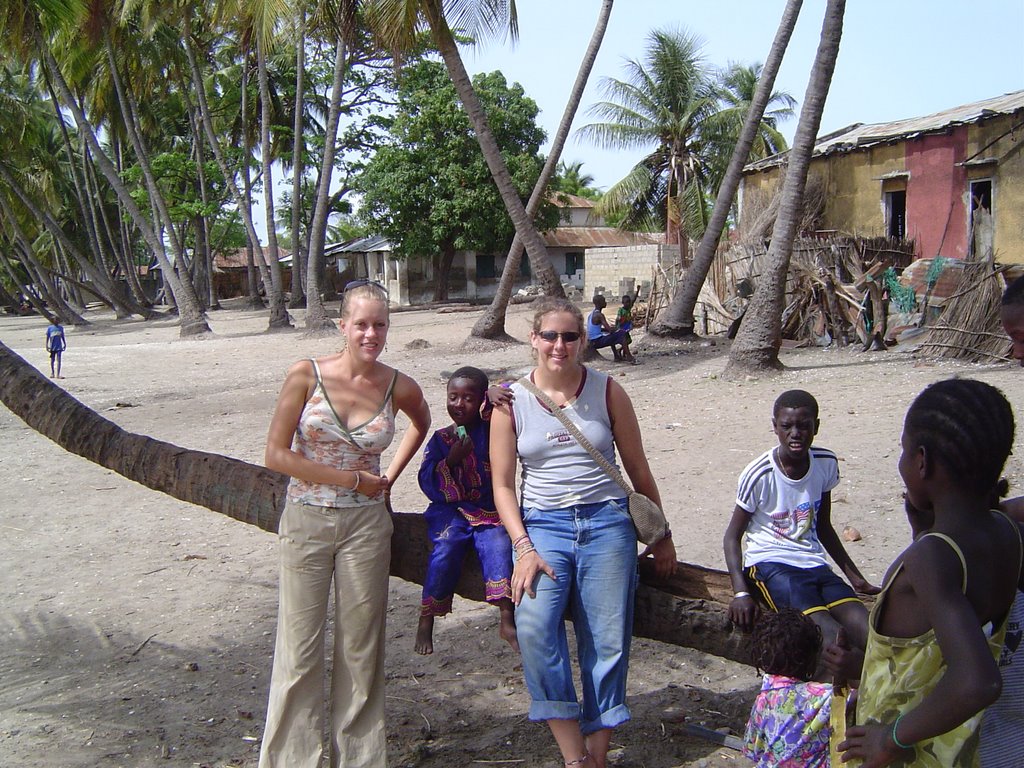
For those of you wondering what this changed person looks like, here's a pick of me a few weeks ago, with my friend Sarah.
Please leave me comments to let me know what you think!
-B
Friday, June 30, 2006
My Running Group
In the past couple years I’ve gotten into jogging, well, at least I don’t hate it anymore. I even ran a half marathon in 2004. This tolerance was partly developed because I realized that its much nicer to run with other people. In Philly I ran with my friends Andrea and Ted, last summer I ran with my sister Leah-had to get her whipped into shape for college swimming. These days I’m still jogging about every other day (when I haven’t stubbed the hell out of my toe), but my running partners are a little different. Thanks to the vacation from school, the neighborhood kids are available to run with me. Yesterday I felt particularly like Forrest Gump in his running days. I started out with a much bigger group that usual – 6 boys ranging in age from 5 to 12 or so. Some of them wore shorts and t-shirts, but some wore everyday pants and long sleeves. Their footwear ranged from decent tennis shoes to crappy flip-flops. As we were running, 4 talibes (the boys who beg for food during the morning in order to learn from the Marabout – religious leader, in the afternoons) joined in, bare-feet, rag-like clothes with their rice bowls tucked under their arms. It didn’t surprise me that they started running, they had done that before, but it did surprise me that they kept running, the entire 40 minutes! When we got back I gave everyone water to drink and gave some rice and sugar to the talibes.
The thing that is starting to get to me is that there are no girls in my little running group. Granted there are many more boys than girls in my neighborhood, but when I went to ask for Bintu, a very athletic 7 or 8 year old girl, this morning, I was told that she was washing clothes and couldn’t come, meanwhile her brother Youssou joined in no problem. In the homes here, daughters are expected to wash clothes, sweep, cook, and many other things around the house to help their mothers. While boys aren’t expected to do any of that stuff and while they do work by running errands and stuff, much of their day is spent playing football in the street. After talking to my host dad about it I realize that its not an idea that is going to be changed in his generation, I’ll have to work on the young people and maybe the mothers who make their daughters do this. Some girls want to do this, after all, being able to keep a house is what is going to win them a husband who can then go out and get up to 3 more wives.
I want to make my mark on this place, showing them that girls and women really can do sports, work as engineers, be president (like in nearby Liberia), that its really not fair that the house work isn’t shared among boys and girls. I just don’t know exactly where to start.
The thing that is starting to get to me is that there are no girls in my little running group. Granted there are many more boys than girls in my neighborhood, but when I went to ask for Bintu, a very athletic 7 or 8 year old girl, this morning, I was told that she was washing clothes and couldn’t come, meanwhile her brother Youssou joined in no problem. In the homes here, daughters are expected to wash clothes, sweep, cook, and many other things around the house to help their mothers. While boys aren’t expected to do any of that stuff and while they do work by running errands and stuff, much of their day is spent playing football in the street. After talking to my host dad about it I realize that its not an idea that is going to be changed in his generation, I’ll have to work on the young people and maybe the mothers who make their daughters do this. Some girls want to do this, after all, being able to keep a house is what is going to win them a husband who can then go out and get up to 3 more wives.
I want to make my mark on this place, showing them that girls and women really can do sports, work as engineers, be president (like in nearby Liberia), that its really not fair that the house work isn’t shared among boys and girls. I just don’t know exactly where to start.
Sunday, June 25, 2006
Successful Training!…well sort of.
This past week something utterly amazing happened, I held 3 trainings that were attended by all 5 people in my formation group plus one unexpected new person. I have been trying to have these trainings for months. The attendees are all Senegalese adults, men and women, with jobs with regional headquarters of national women’s groups and regional government ministries. I started out (foolishly) thinking I could sit down and plan the trainings with the group. Everyone could get out their planners and look at their schedules and say when they were available, on the dates and times that everyone had free we would have the trainings. This sort of organization thing happens billions of times per minute in the US, middle-schoolers do it without a second thought, for sure there would be no problem with my plan, right? Wrong, people showed up to that first meeting from 40 minutes to an hour and 40 minutes late, some didn’t show up at all. At this point I tried emphasizing the importance of coming to meetings on time with a little ‘Time is money’ (a phrase that every Senegalese person knows and attributes to Americans) analogy. If time is money, but I don’t get paid since I’m a volunteer, what is wasted if my time is wasted? -my answer was ‘business development help for the Senegalese people.’ Now I thought that might have been profound and creative enough that it just might work. Oh how naïve I was. Even less people showed up to the following trainings. At this point one of the attendees told me that if I wanted people to show up I had to get the head of the office I’m working with, my supervisor’s supervisor, to make a formal plea to the heads of the attendees’ various organizations. This is where I start pulling my hair out. Why isn’t it enough for me just to ask people when they are available and expect that they show up??? I eventually give in and have my guy call their people. This gets 3 of 5 to show up, between 20 min and an hour late. Through talking to my supervisor I get another suggestion, I need to write a formal convocation with all the info on it and stamped with a cute little seal and drop it off at everyone’s office. Now for some reason, that little piece of paper has made it possible for me to have now 3 trainings where everyone was there no more that 15 minutes late. It has been sort of a strange moment of epiphany for me, on one hand I’ve figured out how to get people to my meetings, on the other, why didn’t the people I was working with and who knew how frustrated I was, let me in on this little insight earlier?
Wait though, the story’s not over yet. All the lessons were also going very well, at least I think they’re getting it. At the end of Thursday’s lesson in how to calculate the costs of an enterprise, my group expressed some concerns. This started with a little complaining that there was nothing for them to drink or snack on during the 2 hour training. The offer was made to get a vender to come through and sell snacks to anyone who wanted to buy. No good, they weren’t interested unless I was buying. Then the problem of paying for the instruction manuals reared its head again, they have asked before if I could use my funds to buy them manuals (13,000 CFA or about $26 for each person) to which I said I’d ask my boss, but I didn’t think it was possible. When I came back to them and told them they would have to buy the books if they wanted them, each of them said they’d save up to buy them. This amount is substantial for them but I believe that it is possible for each of them to save the money and make the investment. Back to the end of my third ‘successful’ lesson, they started saying again that I should pay for their manuals. To this I told them that if they charge people for taking the trainings the books will allow them to give in the future, even a minimal amount, they will make that 13,000 CFA back in one or two trainings, and after that it’ll be extra profit. The fact that this comment didn’t get anyone to stop asking me to pay for the manuals is maybe a sign that the lessons aren’t being learned like I thought they were.
C’est la vie Sénégalese
Wait though, the story’s not over yet. All the lessons were also going very well, at least I think they’re getting it. At the end of Thursday’s lesson in how to calculate the costs of an enterprise, my group expressed some concerns. This started with a little complaining that there was nothing for them to drink or snack on during the 2 hour training. The offer was made to get a vender to come through and sell snacks to anyone who wanted to buy. No good, they weren’t interested unless I was buying. Then the problem of paying for the instruction manuals reared its head again, they have asked before if I could use my funds to buy them manuals (13,000 CFA or about $26 for each person) to which I said I’d ask my boss, but I didn’t think it was possible. When I came back to them and told them they would have to buy the books if they wanted them, each of them said they’d save up to buy them. This amount is substantial for them but I believe that it is possible for each of them to save the money and make the investment. Back to the end of my third ‘successful’ lesson, they started saying again that I should pay for their manuals. To this I told them that if they charge people for taking the trainings the books will allow them to give in the future, even a minimal amount, they will make that 13,000 CFA back in one or two trainings, and after that it’ll be extra profit. The fact that this comment didn’t get anyone to stop asking me to pay for the manuals is maybe a sign that the lessons aren’t being learned like I thought they were.
C’est la vie Sénégalese
Monday, June 19, 2006
Grandma's return
I know, its amazing, two days in a row, but I had to blog about my host grandma's return to the homestead. She had been gone for over a month because her room in our compound was being refurbished, actually overhauled is more like it. They actually litterally raised the roof, maybe the logic is that the hot air will be kept up in the top of the room, the roof is still tin so its still not going to be pleasant in there. So, grandma had been staying in a village where she has some family for the time being, which, I heard she really didn't like. Village life takes some getting used to. Anyway, when I returned from my little trip yesterday she was there and very excited to see me, now excited when one is 100 years old is quite a spectacle to behold. Now if she was excited to see me, when my host sister came in she was moved to tears. It was quite touching even though Maguette was laughing at her. Grandma brought a big bag of mint candies for everyone as a sariche (the gift you bring home after you've traveled) and was passing them out to everyone. Things really didn't seem the same without her down in the courtyard to greet me in the morning so I'm glad the she is back.
Edited 6/24/06 to add: I forgot to mention, because it didn't cross my mind before I saw her back in action, but my host grandma acts also as the gardian of my stairs and keeps the neighborhood kids in line. She often sits at the bottom of the stairs that lead to my room and keeps kids from running up the stairs to my room. This is usually quite a funny site because she is often praying, what else is a 100 year old Senegalese woman going to do all day? And when she's praying, counting the names of Allah, she is forbidden to speak. Some how that has been translated as it's ok to grunt, acknowledge, swipe at kids with a cane, as long as you don't actually pronounce words. So with the paryer beads in one hand she takes a full force swipe
at any kid approaching my steps with the cane in her other hand. Really quite amusing. She also fancies attempting to hit kids with her cane when she's sitting with them outside the house. The kids usually laugh and run away, I guess its all in good fun, for everyone involved.
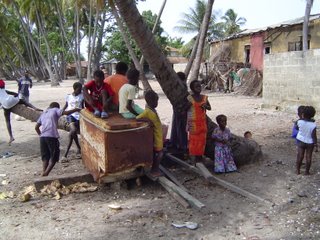
Since I couldn't find a picture of my host grandma, and since I just figured out how to add pictures to the blogs, here is a picture of some cute kids, hanging out on the palm tree.
Edited 6/24/06 to add: I forgot to mention, because it didn't cross my mind before I saw her back in action, but my host grandma acts also as the gardian of my stairs and keeps the neighborhood kids in line. She often sits at the bottom of the stairs that lead to my room and keeps kids from running up the stairs to my room. This is usually quite a funny site because she is often praying, what else is a 100 year old Senegalese woman going to do all day? And when she's praying, counting the names of Allah, she is forbidden to speak. Some how that has been translated as it's ok to grunt, acknowledge, swipe at kids with a cane, as long as you don't actually pronounce words. So with the paryer beads in one hand she takes a full force swipe
at any kid approaching my steps with the cane in her other hand. Really quite amusing. She also fancies attempting to hit kids with her cane when she's sitting with them outside the house. The kids usually laugh and run away, I guess its all in good fun, for everyone involved.
Since I couldn't find a picture of my host grandma, and since I just figured out how to add pictures to the blogs, here is a picture of some cute kids, hanging out on the palm tree.

Sunday, June 18, 2006
Rain

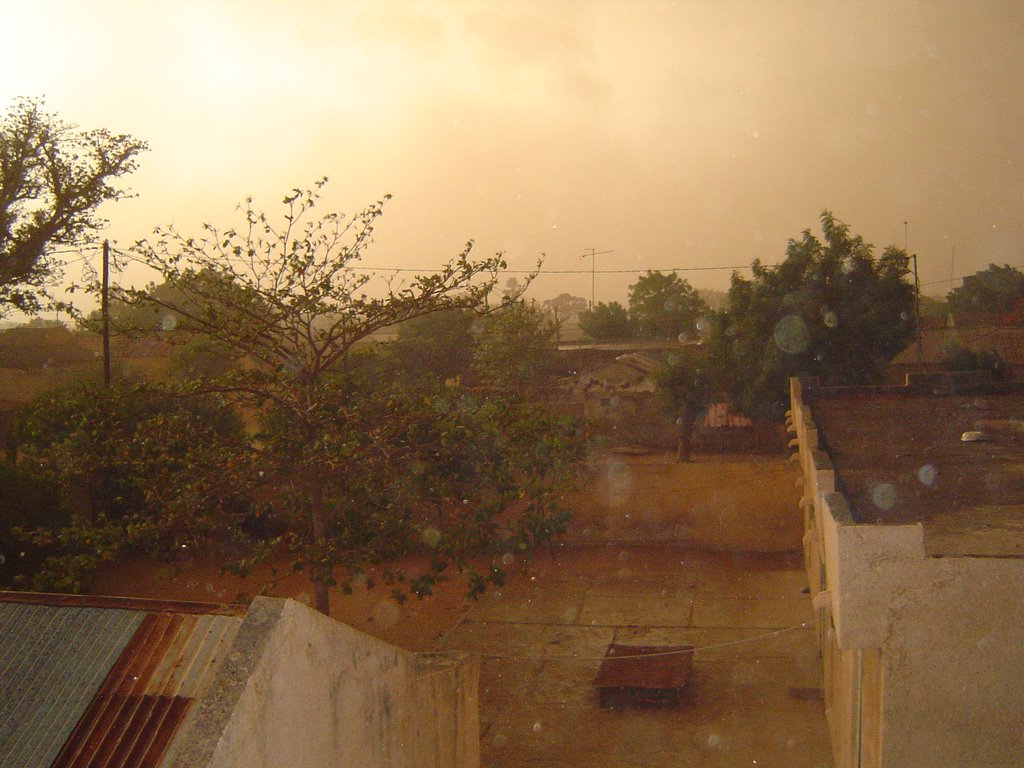
The rainy season is upon us here in Kaolack. It rained a little over a week ago and it rained last night. This is big because before that it really hadn’t rained since September, almost 9 months without precipitation people! Both times the rain approached in dramatic fashion. The first rain was at about 11pm and was preceded by sand being picked up off the ground and flying into my eyes, nose and mouth by powerful winds as I tried to make my way home. Bandana over the face was really the most comfortable way to be if you were outside. As soon as I got home the pitter-patter started on the tin-roofed salon of my host-family. It was slow for about 5 minutes but then quickly turned into a full on monsoon. Yesterday, the storm started at about 6pm so I got to see it approaching. As it came in, it looked like a huge sandstorm, there was a lot of wind and the sky turned dusty brown. The wind picked up and the rain started, it didn’t stop until the middle of the night.
As you might imagine, with the infrastructure being as it is, the drainage is not great after these storms so there are now HUGE puddles in inconvenient places. I know we can expect the fly, mosquito and other annoying insect population to spike now, thankfully I’ve got my industrial strength bug spray to keep me safe.
And to all of you who said ‘well, at least it’s a dry heat.’ It’s not anymore.
Thursday, June 08, 2006
Ch-ch-ch-Changes
So we have this hilarious little cartoon posted at the Kaolack regional house, drawn by some unknown volunteer that highlights the changes that one typically goes through during their 2 years as a PCV. Some of these are weight loss(men) or gain(women), lack of shaving or hair cuts, the dirt that somehow gets embedded into your skin here, henna-ed hands, different types of clothes, different jewelry, different luggage. Basically is says we all go from clean cut and fit with fancy western cloths to protect us from the heat, to dirty long-haired(or sometimes short haired for women) hippies that live like the locals.
So, I figured I'd make a list of some of the things that have changed for me since I've been here.
Then: Didn't wear much jewelry Now: Have a dozen bracelets, a necklace and earrings on as I'm typing
Then: Showered once or twice per day, washing hair each time Now: Shower two to three times per day washing my hair very 5 days or so (hey, shampoo is pricey here)
Then: Flossed maybe a couple times a month Now: Floss nightly and after mangos
Then: Had eaten maybe two mangos in my life Now: eat one or two mangos per day
Then: Coffee every morning Now: Tea every morning (Nescafe is gross)
Then: Took multivitamin when I remembered, once per week Now: Multivitamin and extra vitamin C every day
Then: Went mostly unnoticed while walking through town Now: Get screamed Tubab at wherever I go
Then: Spoke one language Now: Will speak three languages on any given day
Then: Had three figures in my bank account Now: Have six figures in my bank account (in CFA that is)
Then: Hated being sweaty and gross Now: Still hate being sweaty and gross but kinda getting used to it
So, I figured I'd make a list of some of the things that have changed for me since I've been here.
Then: Didn't wear much jewelry Now: Have a dozen bracelets, a necklace and earrings on as I'm typing
Then: Showered once or twice per day, washing hair each time Now: Shower two to three times per day washing my hair very 5 days or so (hey, shampoo is pricey here)
Then: Flossed maybe a couple times a month Now: Floss nightly and after mangos
Then: Had eaten maybe two mangos in my life Now: eat one or two mangos per day
Then: Coffee every morning Now: Tea every morning (Nescafe is gross)
Then: Took multivitamin when I remembered, once per week Now: Multivitamin and extra vitamin C every day
Then: Went mostly unnoticed while walking through town Now: Get screamed Tubab at wherever I go
Then: Spoke one language Now: Will speak three languages on any given day
Then: Had three figures in my bank account Now: Have six figures in my bank account (in CFA that is)
Then: Hated being sweaty and gross Now: Still hate being sweaty and gross but kinda getting used to it
Sunday, May 28, 2006
Maguette's Birthday Party
Wednesday was my host-sister, Maguette's birthday. In honor of the occasion and the occasion of mother's day I took my host mother and host sister out to dinner at a local restaurant. Neither of them had ever been to eat at a restaurant even though there are several in Kaolack, so it was a special occasion. They both got dressed up and Awa put on the perfume I had gotten her for her birthday in April. Maguette has never had pizza so I was sure she'd order it but she played it safe and got the chicken dinner instead, Awa got the steak dinner. It was a little scandalous when they saw some young Senegalese men at another table drinking beer, alcohol is forbidden by Islam, and they seemed a little awkward with eating from plates with a fork and knife on a table but they did much better than I did my first experience at the lunch bowl.
Yesterday was Maguette's birthday party that she's been planning for about a month. On Wednesday she had gotten the ingredients for a birthday cake and frosting, something very unusual here since almost no one has an oven. I got the recipes from my cookbook(also very uncommon here since people just have the senegalese dishes memorized) it was very tricky converting cups to kilos of everything but it worked out, Maguette and her friend helped me make a chocolate cake with butter-creme frosting and while it was baking we watched 'Charlie and the Chocolate Factory' in French, I think they really enjoyed it.
I arrived home yesterday afternoon to blaring Senegalese pop music and a bunch of people; neighbors, relatives and teenaged girls, all dressed up, sitting in a circle around our courtyard, staring at eachother, not appearing to be having a great time. After about 30 minutes a song came on that the girls liked so some of them got up and danced, and after a few songs most of the kids were dancing and it seemed like they were having fun. Eventually I heard an American pop song and got really excited and got up and danced but I soon realized that the song had just been played to clear the floor so the birthday girl could be presented with her presents.
The presentation of gifts was quite strange, each gift giver or group went up to the head table and gave Maguette her gift, Maguette kissed each of them on each cheek a couple time, French style, I then took a photo of them, not smiling of course (they almost never smile for photos), and the next people would come up. A similar little ceremony type thing was done for the birthday candles/singing happy birthday.
After this ther was more dancing (much of it very risque by American standards) and some boys even showed up. Snacks of chips, popcorn with sugar on it and beignets were served and we continued to dance. I was mostly dancing with the little kids from the neighborhood. At 8:45 the music was cut, quite abruptly and everyone cleared out of the courtyard, it was sort of a 'that's it?' moment. The family and close friends that stuck around were offered cake that was a big hit. Saturday night most people with a tv like to watch 'Passions' the really stupid American soap opera, so that's what we did while Maguette opened her gifts. She got 11 pairs of underware - some pretty racy, soap, perfume, candy, cookies and some money, the equivalent of 4 dollars was the most anyone gave, and that was kinda stunning.
After that I wondering what they'll want to do for my birthday, whatever happens, there won't be quite as much Senegalese pop music.
Yesterday was Maguette's birthday party that she's been planning for about a month. On Wednesday she had gotten the ingredients for a birthday cake and frosting, something very unusual here since almost no one has an oven. I got the recipes from my cookbook(also very uncommon here since people just have the senegalese dishes memorized) it was very tricky converting cups to kilos of everything but it worked out, Maguette and her friend helped me make a chocolate cake with butter-creme frosting and while it was baking we watched 'Charlie and the Chocolate Factory' in French, I think they really enjoyed it.
I arrived home yesterday afternoon to blaring Senegalese pop music and a bunch of people; neighbors, relatives and teenaged girls, all dressed up, sitting in a circle around our courtyard, staring at eachother, not appearing to be having a great time. After about 30 minutes a song came on that the girls liked so some of them got up and danced, and after a few songs most of the kids were dancing and it seemed like they were having fun. Eventually I heard an American pop song and got really excited and got up and danced but I soon realized that the song had just been played to clear the floor so the birthday girl could be presented with her presents.
The presentation of gifts was quite strange, each gift giver or group went up to the head table and gave Maguette her gift, Maguette kissed each of them on each cheek a couple time, French style, I then took a photo of them, not smiling of course (they almost never smile for photos), and the next people would come up. A similar little ceremony type thing was done for the birthday candles/singing happy birthday.
After this ther was more dancing (much of it very risque by American standards) and some boys even showed up. Snacks of chips, popcorn with sugar on it and beignets were served and we continued to dance. I was mostly dancing with the little kids from the neighborhood. At 8:45 the music was cut, quite abruptly and everyone cleared out of the courtyard, it was sort of a 'that's it?' moment. The family and close friends that stuck around were offered cake that was a big hit. Saturday night most people with a tv like to watch 'Passions' the really stupid American soap opera, so that's what we did while Maguette opened her gifts. She got 11 pairs of underware - some pretty racy, soap, perfume, candy, cookies and some money, the equivalent of 4 dollars was the most anyone gave, and that was kinda stunning.
After that I wondering what they'll want to do for my birthday, whatever happens, there won't be quite as much Senegalese pop music.
Saturday, May 06, 2006
Some of my favorite things...
As a racial minority here, the volunteers often get a lot of unwanted attention when walking through the market or just walking through town. A lot of people want to come up and talk to you and usually ask you for your watch, money or anything else you might be wearing. I have developed some ways of coping with this and usually getting a good laugh out of the situation.
Some of my favorite things to do to avoid annoying Senegalese people:
-They say: 'Hello my sista! How you, fine?' in the wonderful Gambian English that way too many people here know.
I say (in regular American English): 'I don't speak English'
*This also works and is just as funny if I say the Wolof version or French version.
Or I say: 'Oh my God! You speak English!?!? We can be best friends and I'll come over and speak English with you every day.' Which they never understand and are usually dumbstruck and just end up smiling and nodding.
-They say: 'Are you married?'
I say: 'Yes, I've got two husbands, one to do the cooking and one to do the cleaning.' This is against their gender roles so they usually laugh uncomfortably.
-They say: 'Tubab, give me _______' (choose one; money, your watch, your friend)
I say: ' No, you give me money.' or 'You are rude, go learn how to greet.' or 'Go buy your own.' or 'Go get a job.'
This one really has endless responses but I did get a 'Give me your hat.' from a village woman, to which I said 'Give me your skirt.' taking a note from another volunteer, afterall, whos going to take off their skirt in public? well, that woman did and the other volunteer I was with got flashed. Oh well, it happens.
Some of my favorite things to do to avoid annoying Senegalese people:
-They say: 'Hello my sista! How you, fine?' in the wonderful Gambian English that way too many people here know.
I say (in regular American English): 'I don't speak English'
*This also works and is just as funny if I say the Wolof version or French version.
Or I say: 'Oh my God! You speak English!?!? We can be best friends and I'll come over and speak English with you every day.' Which they never understand and are usually dumbstruck and just end up smiling and nodding.
-They say: 'Are you married?'
I say: 'Yes, I've got two husbands, one to do the cooking and one to do the cleaning.' This is against their gender roles so they usually laugh uncomfortably.
-They say: 'Tubab, give me _______' (choose one; money, your watch, your friend)
I say: ' No, you give me money.' or 'You are rude, go learn how to greet.' or 'Go buy your own.' or 'Go get a job.'
This one really has endless responses but I did get a 'Give me your hat.' from a village woman, to which I said 'Give me your skirt.' taking a note from another volunteer, afterall, whos going to take off their skirt in public? well, that woman did and the other volunteer I was with got flashed. Oh well, it happens.
Sometimes you just have to laugh
So the other day I took my bike down town to run some errands at the epicerie, the tiny grocery store. One of the things I needed was toilet paper, which I'm buying relatively often between the number of guests I have, etc, so when I saw the ten role pack(situated in a 2x5 configuration) I knew that was what I wanted. How was I going to fit it on my bike, well I'd figure that out later. When the time came to figure it out I had the bright idea to shove it between the seat and the center of the handle bars. Needless to say this was tricky, the paper kept slipping out and I had to hold onto it with one hand most of the way. While I was riding I had moto drivers and pedestrians laughing at me meanwhile I'm thinking - screw you! you probably don't even know what this stuff is! - most Senegalese washrooms are stocked with a bucket of water and a cup (dubbed ass-cup by volunteers), not toilet paper. But at the point when I was getting the most frustrated, yelling at moto drivers, juggling the tp and trying to ride my bike, I just had to laugh at myself, it was pretty rediculous.
Sunday, April 30, 2006
French What?
Senegal was a French colony. Now, I don’t know about you but a big part of what I think of when I think of French culture is the wonderful food, pastries, coffee, etc. I have only been to Paris once but I remember those pain au chocolates like it was yesterday, and the coffee was heavenly. A reasonable conclusion would be that some of this would have rubbed off here during the years of occupation, ummmm that’s a negative, the only thing to be found here in Kaolack, and in towns and cities all over Senegal is this stuff that looks a lot like French bread but turns out to be what can only be described as some form of Styrofoam with a hard, crusty outside. And as for the coffee, in addition to the French influence, there are some major coffee-producing countries in this part of the world but that’s another no, unless you go to a nicer restaurant it will be Nescafe instant coffee that you are drinking. A coffee-lover’s nightmare. Leave it to a former French colony to turn me into a true, British-style, tea drinker.
Friday, April 28, 2006
My First (Senegalese) Seder
This is a little after the fact I know but I planned and hosted my first Passover Seder recently. There were 11 volunteers and guests in attendance, several first time seder-goers, and the Seder took place at the Kaolack regional house. In the days leading up to the event I was scouring the internet for Haggadah material to use since the package my parents had sent more than a month earlier, that included Haggadahs and stuff for Matzah ball soup, hadn’t shown up yet (this is not surprising, especially since we just received 5 packages for volunteers who are no longer here, they were sent a year and a half ago). This serendipity led me to the perfect Haggadah, something that was gender-neutral, in English, was inclusive of non-Jews (since I was the only one raised Jewish at my Seder) and as it happens, this Haggadah highlighted themes very pertinent to our lives as volunteers, like always asking questions, the importance of community, liberation of the mind through education and exploration and of course, striving for a time when the world is in peace (a more secular view of the Messianic era).
The day of had some very stressful moments including searching for everything I needed in the Kaolack market (see previous blog) and figuring out exactly what we were going to eat and how I was going to prepare it in the kitchen here. We had to make our own Matzah which I guess wouldn’t really be considered kosher since we just used the flour we could find. We got some help from people that had traveled to Dakar, the site of the only supermarkets in the country, as far as walnuts for the charoset. These folks also looked for horseradish, something entirely necessary in any Seder as far as I’m concerned but no luck, no horseradish in Senegal. Senegal does, however, have something that is the most bitter thing I’ve ever tasted – Kola Nut. Senegalese people eat these things to increase their energy, they are so bitter that ANYTHING you eat after a Kola Nut will taste sweet. So for a local twist we used shredded Kola Nut as our bitter herb, and it ended up tasting pretty good in the Hillel Sandwich. A shank bone was no problem with so many sheep here, and in true Passover miracle form, the package showed up just in time so we had our Matzah ball soup, which everyone was raving about if I do say so myself. Our menu included the soup, delicious potato and niçoise salads and a goulash that were contributed by other volunteers, we had a fruit salad for dessert with mangoes, oranges, bananas and apples, and of course lots of wine, boxed wine(a favorite of volunteers). This didn’t seem like it was an insane amount of food, especially compared to the Seders I remember having at my Aunt Rosalee and Uncle Herbie’s house in Milwaukee, but I, for one, was pretty full after the soup. We gave the leftovers to the guards who were much less weirded-out by the shredded Kola Nut than I thought they’d be.
I had a lot of people tell me that they really enjoyed the evening and I really enjoyed starting a new tradition here so if next year is not “in Jerusalem” it’ll be in Kaolack, Bismilah! (Welcome!)
Edited May 6th, 2006 to add:
After I typed this whole thing up I realized that I didn't note how supportive my host family, mainly my host mother, was during Passover. A few weeks ahead of time I told her that there was a Jewish holiday coming up, during which I couldn't eat bread for 8 days. She looked at me crosseyed for a second, not eating bread is not exactly normal here, but after that she didn't miss a beat, the main meal that it affected was breakfast when I usually have a bean sandwich. She said 'No problem, I'll just cook you two eggs and salad for breakfast every morning.' She was even asking if I could eat rice, a staple here, for lunch. She was willing to make me salad for lunch too, but I decided to go the Sephardic route and allow myself to eat rice but just stay away from bread. I was very touched, as I am daily, by how inviting they are.
The day of had some very stressful moments including searching for everything I needed in the Kaolack market (see previous blog) and figuring out exactly what we were going to eat and how I was going to prepare it in the kitchen here. We had to make our own Matzah which I guess wouldn’t really be considered kosher since we just used the flour we could find. We got some help from people that had traveled to Dakar, the site of the only supermarkets in the country, as far as walnuts for the charoset. These folks also looked for horseradish, something entirely necessary in any Seder as far as I’m concerned but no luck, no horseradish in Senegal. Senegal does, however, have something that is the most bitter thing I’ve ever tasted – Kola Nut. Senegalese people eat these things to increase their energy, they are so bitter that ANYTHING you eat after a Kola Nut will taste sweet. So for a local twist we used shredded Kola Nut as our bitter herb, and it ended up tasting pretty good in the Hillel Sandwich. A shank bone was no problem with so many sheep here, and in true Passover miracle form, the package showed up just in time so we had our Matzah ball soup, which everyone was raving about if I do say so myself. Our menu included the soup, delicious potato and niçoise salads and a goulash that were contributed by other volunteers, we had a fruit salad for dessert with mangoes, oranges, bananas and apples, and of course lots of wine, boxed wine(a favorite of volunteers). This didn’t seem like it was an insane amount of food, especially compared to the Seders I remember having at my Aunt Rosalee and Uncle Herbie’s house in Milwaukee, but I, for one, was pretty full after the soup. We gave the leftovers to the guards who were much less weirded-out by the shredded Kola Nut than I thought they’d be.
I had a lot of people tell me that they really enjoyed the evening and I really enjoyed starting a new tradition here so if next year is not “in Jerusalem” it’ll be in Kaolack, Bismilah! (Welcome!)
Edited May 6th, 2006 to add:
After I typed this whole thing up I realized that I didn't note how supportive my host family, mainly my host mother, was during Passover. A few weeks ahead of time I told her that there was a Jewish holiday coming up, during which I couldn't eat bread for 8 days. She looked at me crosseyed for a second, not eating bread is not exactly normal here, but after that she didn't miss a beat, the main meal that it affected was breakfast when I usually have a bean sandwich. She said 'No problem, I'll just cook you two eggs and salad for breakfast every morning.' She was even asking if I could eat rice, a staple here, for lunch. She was willing to make me salad for lunch too, but I decided to go the Sephardic route and allow myself to eat rice but just stay away from bread. I was very touched, as I am daily, by how inviting they are.
Wednesday, April 26, 2006
The Wonders of RTS
I was told that I need to blog more so here goes. I watch some TV here most nights, as long as I’m at home and there is power. There is one main TV channel here - RTS1, there is also TV5, a French channel but I think you may need a special antenna to get it and it is very fuzzy at my house so I don’t watch it. The wealthy people get satellite dishes that give them access to a bunch more, mostly French channels. RTS1 has the news in French, Wolof, Pulaar, Sereer and maybe a couple other local languages during the day. The highlight for many volunteers is Muneca Brava, an Argentinean soap opera that has been dubbed in French and edited to take out the kissing scenes but not the incredibly skimpy outfits that some women wear. Like any soap opera it is completely ridiculous but it is sometimes entertaining and it’s really entertaining to witness my Senegalese family’s reactions to the on-screen antics. During the day there is a nature documentary, followed by a rerun of last night’s Muneca Brava. There are Wolof game shows with sets that look like public access hand-me-downs and there is also a Muslim game show where they have to answer questions about the Koran. For some reason this reminds me of the SNL sketch of the Japanese game show where people get fingers cut off for an incorrect response - I don’t really know why, I’ve never seen any loss of digits. On weekends there are cartoons in the mornings - Scooby Doo and Looney Tunes dubbed in French - all of which are called "Mickey" here. Weekend evenings used to be "Married With Children" most of us didn’t really appreciate that this was the image of Americans that was being shown over seas, now it’s a show with Damon Wayans, I’m not sure if the African American element is appreciated here or not. After the news is "Passions" the horrible American soap opera - it seems to be my brother Guelaye’s (the pious one) favorite, and "24" the American show which I still haven’t gotten into but I have heard is good, here its "24(vingt quatre) Heures Chrono." "The Young and the Restless" is also somewhere in the lineup but I’m not exactly sure where, it also has a different name.
It may not seem like in from my description above but news really does seem to dominate RTS. And the thing with the news here is that it is partly owned and run by the government, this makes for wonderful 10 minute long stories that show various ministers, all in their grand booboos, walking into the presidential palace. Also when Abdoulaye Wade(the president, always referred to on the news as "Son excellence, maitre Abdoulaye Wade) is out promoting himself at least half the news is devoted to him sticking out the top of his SUV shaking hands with the rowdy crowd that is only there to try to be on TV. I have a theory that this means that the bad stuff Wade does, like putting a canal through a national park to reduce floodwaters, which has now eroded away much of the park and several villages, isn’t reported. I have also heard that if you want to get something that’s not government related on the news, you must pay for it. I had to hear on the BBC that there was a conflict in the Casamance region of Senegal between rebels and troops from Guinea Bissau. In my opinion, RTS does a very poor job of informing the Senegalese people about things they should know. There is one thing that it does an ok job of and that is international news. For example, there was recently a bombing in a resort town in the Sinai Peninsula in Egypt, they didn’t show gratuitous blood and guts but they didn’t edit out the visual evidence that people had been injured and died there.
This is where I start comparing to news in the US. The US news is careful not to show us blood on the street after a suicide bomber attack, so people may have a glossed over idea about what the situation is really like in Iraq for example. THANK GOD the US news is not run by the government but they lead with stories of kidnapped spring breakers and missing, young, pregnant wives that some how keep the attention of the entire nations for months. They also do their best to create a fear that will keep us glued to the screen, "Something you have in your kitchen could kill you and your family and your pets, find out details at eleven." Does this sound familiar? Hmm, what is it this time, the butcher knives, the detergent, the bleach, something in the food is going to give me cancer????
I still haven’t figured out which news is worse, not sure I ever will, but I do know one thing, I am very glad that my short wave radio picks up BBC News and that I can also listen to NPR occasionally on the world space radio at the regional house.
How was that for a blog AJ?
It may not seem like in from my description above but news really does seem to dominate RTS. And the thing with the news here is that it is partly owned and run by the government, this makes for wonderful 10 minute long stories that show various ministers, all in their grand booboos, walking into the presidential palace. Also when Abdoulaye Wade(the president, always referred to on the news as "Son excellence, maitre Abdoulaye Wade) is out promoting himself at least half the news is devoted to him sticking out the top of his SUV shaking hands with the rowdy crowd that is only there to try to be on TV. I have a theory that this means that the bad stuff Wade does, like putting a canal through a national park to reduce floodwaters, which has now eroded away much of the park and several villages, isn’t reported. I have also heard that if you want to get something that’s not government related on the news, you must pay for it. I had to hear on the BBC that there was a conflict in the Casamance region of Senegal between rebels and troops from Guinea Bissau. In my opinion, RTS does a very poor job of informing the Senegalese people about things they should know. There is one thing that it does an ok job of and that is international news. For example, there was recently a bombing in a resort town in the Sinai Peninsula in Egypt, they didn’t show gratuitous blood and guts but they didn’t edit out the visual evidence that people had been injured and died there.
This is where I start comparing to news in the US. The US news is careful not to show us blood on the street after a suicide bomber attack, so people may have a glossed over idea about what the situation is really like in Iraq for example. THANK GOD the US news is not run by the government but they lead with stories of kidnapped spring breakers and missing, young, pregnant wives that some how keep the attention of the entire nations for months. They also do their best to create a fear that will keep us glued to the screen, "Something you have in your kitchen could kill you and your family and your pets, find out details at eleven." Does this sound familiar? Hmm, what is it this time, the butcher knives, the detergent, the bleach, something in the food is going to give me cancer????
I still haven’t figured out which news is worse, not sure I ever will, but I do know one thing, I am very glad that my short wave radio picks up BBC News and that I can also listen to NPR occasionally on the world space radio at the regional house.
How was that for a blog AJ?
Tuesday, March 14, 2006
Polygamy, up close
The other night I had a very interesting conversation with my host mom about polygamy. My host mom, Awa, married my host dad, Tidiane in 1978, and in early 1979 my host sister - Fatim was born. Awa and Tidiane have 5 children, Fatim is the oldest at 27 and Magette is the youngest at nearly 14, and between them are three boys - Malik, Guelaye and Baba. About 5 years ago, Tidiane decided he was going to take another wife. In Senegal it is legal for a man to have up to four wives though the gov’t is working to discourage polygamy now. Polygamy is also legal in the eyes of Islam, which also allows up to 4 but with the disclaimer that they all must be treated exactly equally - something next to impossible to do even with two wives, thus some theorize that Islam doesn’t REALLY condone polygamy. So back to my host family - as is common practice here, Tidiane didn’t inform Awa of his intentions until the day of his wedding with Soda - his second wife (Often, men here don’t even have the courage to face their 1st wives and tell them so they sometimes send a messenger in the form of a family member, or even don’t tell until after the ceremony). This was, as is typical, a huge blow to Awa. Even though it is commonplace here, rarely do women see it coming and even more rarely are they ok with it. All Awa could say to me about the situation was "Polygamy, it’s bad, it’s really bad." As it turns out, Soda is several years older than Awa and was past childbearing age when Tidiane married her so she doesn’t have children of her own. Awa’s kids tolerate Soda for the most part, as does Awa, though Awa told me that Soda had been known to boss her kids around and that at least Guelaye really doesn’t like her. Soda lives in the next neighborhood over and we see her about once per week and on holidays. Tidiane has split up his time between the two sleeping at our compound (though he and Awa have separate bedrooms) weeknights and at Soda’s place weekends (not exactly equal treatment). In the village, Polygamy takes on a much different feel because most of the time, all the wives live in the same compound and share the cooking, cleaning and other chores.
As I spoke to Awa about her situation I thought about what I would’ve done in her situation, the gut reaction was divorce. To me it seemed like the ultimate expression of disrespect, but I soon realized that for Awa divorce was not an option. She got married when she was still in lycée (high school) and soon became pregnant and had to drop out before finishing. She’s been a housewife her entire adult life and as the woman in the relationship - education of the children is her responsibility. Both her parents have passed away and so without support of her husband she really would have no support for herself and possibly her 5 kids. This leaves typical Senegalese women that don’t work outside the house with no options, just deal with it as best you can, suffer in silence.
My host grandma; Mariemme (Tidiane’s mother) had possibly an even worse situation. She was the first wife as well and eventually her husband took another wife. After a couple months he divorced the 2nd wife, but he soon married again. This marrying and divorcing process happened 6 times, all the while Mariemme cooked, cleaned and raised this man’s children like a good Senegalese wife.
There may be some hope for the future though. More women are getting higher educations and can support themselves if need be - Fatim is working on a degree at the university in Dakar. With registered marriages, couples are required to determine at registration of the first marriage whether the marriage is going to be polygamous and if so how many wives the man will have. Men are allowed to have less than first contracted but if they say 2, that’s the maximum they are legally allowed from then on. You can imagine there is some pressure on the wedding day to make it a non-polygamous marriage. I asked Awa if she thought any of her 3 sons would take more than one wife, she thought about it and said she didn’t think so - that they had a hard time with Soda becoming part of the family and that hopefully they’d remember how it effects the entire family. I hope that she’s right but then again, Tidiane went through his father taking other wives when he was growing up, the cycle was unbroken.
As I spoke to Awa about her situation I thought about what I would’ve done in her situation, the gut reaction was divorce. To me it seemed like the ultimate expression of disrespect, but I soon realized that for Awa divorce was not an option. She got married when she was still in lycée (high school) and soon became pregnant and had to drop out before finishing. She’s been a housewife her entire adult life and as the woman in the relationship - education of the children is her responsibility. Both her parents have passed away and so without support of her husband she really would have no support for herself and possibly her 5 kids. This leaves typical Senegalese women that don’t work outside the house with no options, just deal with it as best you can, suffer in silence.
My host grandma; Mariemme (Tidiane’s mother) had possibly an even worse situation. She was the first wife as well and eventually her husband took another wife. After a couple months he divorced the 2nd wife, but he soon married again. This marrying and divorcing process happened 6 times, all the while Mariemme cooked, cleaned and raised this man’s children like a good Senegalese wife.
There may be some hope for the future though. More women are getting higher educations and can support themselves if need be - Fatim is working on a degree at the university in Dakar. With registered marriages, couples are required to determine at registration of the first marriage whether the marriage is going to be polygamous and if so how many wives the man will have. Men are allowed to have less than first contracted but if they say 2, that’s the maximum they are legally allowed from then on. You can imagine there is some pressure on the wedding day to make it a non-polygamous marriage. I asked Awa if she thought any of her 3 sons would take more than one wife, she thought about it and said she didn’t think so - that they had a hard time with Soda becoming part of the family and that hopefully they’d remember how it effects the entire family. I hope that she’s right but then again, Tidiane went through his father taking other wives when he was growing up, the cycle was unbroken.
Friday, March 10, 2006
Home Sweet Home…sorta
Well I’m back in Kaolack after nearly a month away for training. I returned to Kaolack to the Sine-Saloum heat and a nearly finished apartment. My new place is great, my host dad calls it “The White House in the Sky” – I think he had it painted white on purpose. At first glance it may very well be nicer than any of the apartments I lived in as a student, but then after living in it a little while you come to realize that it’s still the same shoddy work as most of the buildings around here. The folks who laid the tile ended up getting cement all over that refuses to come off, the shower doesn’t drain properly and the screens and windows have space between them for any malaria-ridden mosquito to fly right in (don’t worry, I’ve taken care of that one with duct tape!). Oh well, it only has to last a couple more years right? I don’t want to seem like I’m complaining though, I really am quite lucky that I have all the amenities I do. Some of my visitors have even said “Wow, it’s like I’m not even in Senegal anymore.” It’s like my own little oasis. We’ll see how it goes with the rainy season.
Speaking of seasons, I am frightened. My group got here at the very end of the rainy season and I remember it seeming pretty hot but I was chalking that up to the adjustment from mid-west autumn. The “cool” season (Nov – March) in Kaolack means that at night it cools off slightly and you don’t need to sleep with a fan blowing in your face – I was actually using a thin blanket for a little while there. During the day it’s still hot as H E double hockey sticks. Thus my fear – I’ve been told that there are three levels of hot here; “Wow its hot!” “Oh my God its really hot!” and “Holy sh*t, it’s so f*cking hot if I move I may die!” I’ll keep you posted on that.
What have I done in the last month?? Well, I went to the beach, sunbathed and swam in the Atlantic Ocean, I hung out with my pals from my stage, drank some wine and beer, ate some burgers, Went to Dakar where I played some softball, ate a couple hotdogs(imported from the US), ran into someone in a bar who knows my sister, got kicked in the arm by some jerk in the French military who can’t hold his liquor, was voted one of the new fund-raising coordinators for SeneGAD (Peace Corps Senegal’s Gender and Development group – works mostly with girls clubs), got into a couple heated discussions about the infamous Danish political cartoon, hosted my first visitor from the US, learned some good techniques for business development and training, came up with a plan my the next 6 months here, cleaned and setup my new room and celebrated International Day of the Woman(March 8th) in style. So now after that huge run-on sentence I’m ready to start working. I’ve got several projects in mind so hopefully I’m not spreading myself too thin, only time will tell.
I’ll be posting photos soon so be sure to check www.lespritdebecca.shutterfly.com
Speaking of seasons, I am frightened. My group got here at the very end of the rainy season and I remember it seeming pretty hot but I was chalking that up to the adjustment from mid-west autumn. The “cool” season (Nov – March) in Kaolack means that at night it cools off slightly and you don’t need to sleep with a fan blowing in your face – I was actually using a thin blanket for a little while there. During the day it’s still hot as H E double hockey sticks. Thus my fear – I’ve been told that there are three levels of hot here; “Wow its hot!” “Oh my God its really hot!” and “Holy sh*t, it’s so f*cking hot if I move I may die!” I’ll keep you posted on that.
What have I done in the last month?? Well, I went to the beach, sunbathed and swam in the Atlantic Ocean, I hung out with my pals from my stage, drank some wine and beer, ate some burgers, Went to Dakar where I played some softball, ate a couple hotdogs(imported from the US), ran into someone in a bar who knows my sister, got kicked in the arm by some jerk in the French military who can’t hold his liquor, was voted one of the new fund-raising coordinators for SeneGAD (Peace Corps Senegal’s Gender and Development group – works mostly with girls clubs), got into a couple heated discussions about the infamous Danish political cartoon, hosted my first visitor from the US, learned some good techniques for business development and training, came up with a plan my the next 6 months here, cleaned and setup my new room and celebrated International Day of the Woman(March 8th) in style. So now after that huge run-on sentence I’m ready to start working. I’ve got several projects in mind so hopefully I’m not spreading myself too thin, only time will tell.
I’ll be posting photos soon so be sure to check www.lespritdebecca.shutterfly.com
Tuesday, February 14, 2006
Tad Bit Nippy
So I'm in Africa, Senegal to be specific. I'm wearing long pants, a t-shirt and sweatshirt and I'm comfortable, NOT sweating. This is a new sensation for me. I have left Kaolack aka 'the oven' to return to Thies for 3 more weeks of training and I really wasn't mentally prepared for the weather I found. Only a 3 hours drive and its about a 20 degree difference. Also a bit strange is that when I left Thies and my family here, I spoke and understood relatively little Wolof and I guess now I understand more, because now I can actually understand my family at the dinner bowl. It's really great to see the volunteers that I haven't seen in the 2.5 months we were at site and its also great to hear about the varied experiences we've had. This weekend there is a wild crazy time called WAIST (West African Invitational Softball Tournament) where ex-pats, volunteers, etc from all the countries in west Africa descend on Dakar for a weekend of softball and general debaucherie. We are all looking forward to it because not only will it be a nice time to relax and have fun, but we will be able to network and get to know ex-pats and the other volunteers. Let you know how it goes.
Monday, January 23, 2006
Tabaski
So, Back on Jan 11 there was another holiday here; Tabaski. Tabaski celebrates Abraham nearly sacrificing his son - Ishmael (Judeo-Christian beliefis that it was his other son Isaac). The story goes that at the last second, God stopped Abraham from slaughtering his son and provided aram instead. Yeah, so the tradition here is for each family to slaughter a sheep so there has been an influx of adult, male sheep here in town the past couple weeks. For me, seeing these guys is like 'dead sheep walking,' its a weird feeling, *knowing* that these animals that I'm looking at right now will all be dead and lunch in a few days. So I decided to write a poem, enjoy.
"Something Strange is Happening"
(Written from the point of view of a male sheep, before Tabaski)
Something strange is happening,I don't know if I should be alarmed.
My boss has sent me and all the other males my age to the city.
There are many others like us here, thousands.
We're being herded to crowded marketplaces.
I see some being strapped to the roofs of cars.
I see some being lead, struggling, by a rope around the neck.
I see some being being taken in twos and threes.
I don't see any females or young ones.
I don't see any goats,
I don't see any cows.
Just myself and others like me,
and the people, herding, buying, taking home.
In the market people are preparing for something.
They buy new clothes, they buy lots of food, they buy others like me,and the they buy me.
Now, I am lead by a rope around my neck.
Now, I am put in a rice sack and tied to the top of a car.
I am taken off the car and tied up in a strange yard.
There are lots of smiling faces here.
There are lots of happy sounds in this yard.
It seems no one here needs to sacrifice.
I too am given all the food I can eat, and I eat.
They speak of tomorrow with great anticipation and send strange looks my way.
Something strange is happening, I don't know if I should be alarmed.
**End of Poem**
So as with the other holidays here, everyone gets fancy new clotheswhether they can afford it or not, the women all get new hair (I'm still getting used to the idea of everyone and their mother having giant hair extensions), and an animal is killed and eaten. Even I was sucked in this time, I had henna put on my hands and fingertips and I had my hair braided (it looked pretty silly, you can see photos at www.lespritdebecca.shutterfly.com). Tabaski is also the Muslim new year I guess, so Happy NewYear...again!
"Something Strange is Happening"
(Written from the point of view of a male sheep, before Tabaski)
Something strange is happening,I don't know if I should be alarmed.
My boss has sent me and all the other males my age to the city.
There are many others like us here, thousands.
We're being herded to crowded marketplaces.
I see some being strapped to the roofs of cars.
I see some being lead, struggling, by a rope around the neck.
I see some being being taken in twos and threes.
I don't see any females or young ones.
I don't see any goats,
I don't see any cows.
Just myself and others like me,
and the people, herding, buying, taking home.
In the market people are preparing for something.
They buy new clothes, they buy lots of food, they buy others like me,and the they buy me.
Now, I am lead by a rope around my neck.
Now, I am put in a rice sack and tied to the top of a car.
I am taken off the car and tied up in a strange yard.
There are lots of smiling faces here.
There are lots of happy sounds in this yard.
It seems no one here needs to sacrifice.
I too am given all the food I can eat, and I eat.
They speak of tomorrow with great anticipation and send strange looks my way.
Something strange is happening, I don't know if I should be alarmed.
**End of Poem**
So as with the other holidays here, everyone gets fancy new clotheswhether they can afford it or not, the women all get new hair (I'm still getting used to the idea of everyone and their mother having giant hair extensions), and an animal is killed and eaten. Even I was sucked in this time, I had henna put on my hands and fingertips and I had my hair braided (it looked pretty silly, you can see photos at www.lespritdebecca.shutterfly.com). Tabaski is also the Muslim new year I guess, so Happy NewYear...again!
Monday, January 16, 2006
The Market
Kaolack is home to the second largest covered market in Africa, the largest is somewhere in Morocco. The market takes up 4-5 full blocks and is full of people selling just about anything – though not much of real quality. There dozens of boutiques that sell mostly small food stuffs like the bouillon cubes that are used in every Senegalese dish, pasta, rice, butter, powdered milk, instant coffee, sugar, etc – all of which can be bought it absolutely any quantity. For example, at a boutique one can buy a carton of cigarettes, or they can buy one cigarette – either way, much cheaper than in the US by the way, one can buy a tub of margarine or they can buy 20 CFA (4 cents) worth of margarine smeared on a piece of paper. Boutiques are also found in residential areas, in towns and in some villages.
In the market fresh food can also be bought. There is a fish market that stinks to high heaven and has scales all over the floor. There are several places were fresh veggies can be bought and there is also a butchery type area that I try to avoid. No matter what the food, there are usually dozens of flies buzzing around each table and crawling over all the food, this doesn’t bother me, I can’t remember if it ever did. There is also a bigger, open room that appears to be devoted to spices. There are several tables set up with rice sacks overflowing with spices that I couldn’t begin to tell you what they are, but all mixed together they certainly smell funky.
The Fukki Jaay section is a bunch of stands selling second hand clothes, mostly from the U.S. and Europe. It is usually quite entertaining to see the Senegalese walking around in these t-shirts that are so out of place, and its also entertaining to look through the piles, I always get a kick out of seeing a shirt that connects back to my life in the states, and the other day I saw a Family Land, Wisconsin Dells shirt and a WIAA Okonomowoc Girls State Basketball tshirt. I keep wondering if some of the clothes my family has donated has ended up here, I did see a pair of Umbro shorts the other day that looked very familiar.
In the clothes department there are also slightly nicer looking shops that sell knockoffs of Puma, Adidas, Nike, Dolce and Gabana, Converse, you name it. They also sell the newer looking of the second hand t-shirts – I had a guy try to sell me the t-shirt off his back the other day, it said “Democrats are sexier. Who ever heard of a fine piece of elephant?” In the end I offered a price lower than they would except because I knew that its just funnier on a young Senegalese man who doesn’t know what it says.
There are also rows and rows of fabric shops and tailors. I have heard that the fabric here is cheaper because it comes in, illegally no doubt, from the Gambia. There are some plain, colored fabrics in just about any color you could want but there are also some great patterns that often incorporate something like cell phones, chickens, the New York Yankees symbol or (like one of my fabrics) umbrellas and parasols. Many of these fabrics have color combinations that I’m sure would be found atrocious by most westerners, but, as I found when I went shopping with my aunt and neighbour for fabric for my Tabaski outfit, Senegalese think is beautiful. I ended up getting a fabric that has orange and a deep burgundy along with turquoise, and I think it has a mosque or something on it. To get a woman’s outfit made, 3 to 4 meters of fabric are needed and together with what the tailor charges the total cost is usually about $20 – 10,000 CFA.
The market has a very narrow aisle of beauty supply stores that sell hair, hair products and shoes, some clothes. The hair is sold in plastic packages, I’m not sure if one package is enough to complete extensions on an entire head and I’m not sure how much they cost, but I do know that it took sessions of several hours per day for 3 days for my aunt to finish this woman’s hair for Tabaski. The hair was black at the top and reddish pink at the bottom, which must have been stylish this year because I saw a lot of it. I may be nuts but I’m thinking of trying out the fake hair. I’m curious, and here everyone does it, I wouldn’t be able to get away with it back home. I’ll be sure to take pictures if I ever do get that crazy.
The rest of the market is made up of random shops that sell jewellery, peanuts, ready made Senegalese clothes, office supplies, cell phones and Senegalese household and kitchen supplies. The paths that lead between the shops are cement slabs, some of which are covering a crude drainage system. Some of this drainage system is uncovered so I find myself looking down much of the time so I don’t step into something unsavoury. This also gives some parts of the market a…distinct odor. There are also public toilettes that I really hope I NEVER have to use.
The market is sort of set in a grid and the walkways are pretty narrow, some of them are very narrow and tend to cause traffic jams on the average day, but leading up to Tabaski it was a while different story. The market was jam packed with people trying to buy stuff for the holiday. I was constantly being shoved and having to shove to get anywhere. It was absolutely nuts in there.
All that being said, I have to say that the market is one of my favorite places in Kaolack, even with the vendors tripling the price for me because I’m white, even with the annoying but necessary haggling, even with the less than pleasant smells, I look forward to learning my way around it and meeting the people that work there. I think it’s because it makes me feel like I am really in Africa when I’m making my way through the maze.
In the market fresh food can also be bought. There is a fish market that stinks to high heaven and has scales all over the floor. There are several places were fresh veggies can be bought and there is also a butchery type area that I try to avoid. No matter what the food, there are usually dozens of flies buzzing around each table and crawling over all the food, this doesn’t bother me, I can’t remember if it ever did. There is also a bigger, open room that appears to be devoted to spices. There are several tables set up with rice sacks overflowing with spices that I couldn’t begin to tell you what they are, but all mixed together they certainly smell funky.
The Fukki Jaay section is a bunch of stands selling second hand clothes, mostly from the U.S. and Europe. It is usually quite entertaining to see the Senegalese walking around in these t-shirts that are so out of place, and its also entertaining to look through the piles, I always get a kick out of seeing a shirt that connects back to my life in the states, and the other day I saw a Family Land, Wisconsin Dells shirt and a WIAA Okonomowoc Girls State Basketball tshirt. I keep wondering if some of the clothes my family has donated has ended up here, I did see a pair of Umbro shorts the other day that looked very familiar.
In the clothes department there are also slightly nicer looking shops that sell knockoffs of Puma, Adidas, Nike, Dolce and Gabana, Converse, you name it. They also sell the newer looking of the second hand t-shirts – I had a guy try to sell me the t-shirt off his back the other day, it said “Democrats are sexier. Who ever heard of a fine piece of elephant?” In the end I offered a price lower than they would except because I knew that its just funnier on a young Senegalese man who doesn’t know what it says.
There are also rows and rows of fabric shops and tailors. I have heard that the fabric here is cheaper because it comes in, illegally no doubt, from the Gambia. There are some plain, colored fabrics in just about any color you could want but there are also some great patterns that often incorporate something like cell phones, chickens, the New York Yankees symbol or (like one of my fabrics) umbrellas and parasols. Many of these fabrics have color combinations that I’m sure would be found atrocious by most westerners, but, as I found when I went shopping with my aunt and neighbour for fabric for my Tabaski outfit, Senegalese think is beautiful. I ended up getting a fabric that has orange and a deep burgundy along with turquoise, and I think it has a mosque or something on it. To get a woman’s outfit made, 3 to 4 meters of fabric are needed and together with what the tailor charges the total cost is usually about $20 – 10,000 CFA.
The market has a very narrow aisle of beauty supply stores that sell hair, hair products and shoes, some clothes. The hair is sold in plastic packages, I’m not sure if one package is enough to complete extensions on an entire head and I’m not sure how much they cost, but I do know that it took sessions of several hours per day for 3 days for my aunt to finish this woman’s hair for Tabaski. The hair was black at the top and reddish pink at the bottom, which must have been stylish this year because I saw a lot of it. I may be nuts but I’m thinking of trying out the fake hair. I’m curious, and here everyone does it, I wouldn’t be able to get away with it back home. I’ll be sure to take pictures if I ever do get that crazy.
The rest of the market is made up of random shops that sell jewellery, peanuts, ready made Senegalese clothes, office supplies, cell phones and Senegalese household and kitchen supplies. The paths that lead between the shops are cement slabs, some of which are covering a crude drainage system. Some of this drainage system is uncovered so I find myself looking down much of the time so I don’t step into something unsavoury. This also gives some parts of the market a…distinct odor. There are also public toilettes that I really hope I NEVER have to use.
The market is sort of set in a grid and the walkways are pretty narrow, some of them are very narrow and tend to cause traffic jams on the average day, but leading up to Tabaski it was a while different story. The market was jam packed with people trying to buy stuff for the holiday. I was constantly being shoved and having to shove to get anywhere. It was absolutely nuts in there.
All that being said, I have to say that the market is one of my favorite places in Kaolack, even with the vendors tripling the price for me because I’m white, even with the annoying but necessary haggling, even with the less than pleasant smells, I look forward to learning my way around it and meeting the people that work there. I think it’s because it makes me feel like I am really in Africa when I’m making my way through the maze.
Subscribe to:
Posts (Atom)