This week there is a pilgrimage to one of the neighborhoods in Kaolack to celebrate the Gamou. Last year I stayed as far away from that quartier as possible but this year I decided to check it out with my friend Ndeye – she’s a mechanic. The quartier – Medina Baay, is home to a huge, Moroccan style mosque that was built by one of the Sufi Islam Brotherhoods that are centered in Senegal. This brotherhood is called the Baay Niass brotherhood, named after its founder but the unique thing about this brotherhood is that they have lots of American talibe (followers). I was told that there are several that have even moved here permanently to be close to their spiritual leader, but mostly the Americans visit Medina Baay for a couple weeks every year to partake in the pilgrimage.
So I started with dinner at Ndeye’s house (Ndeye’s family aren’t followers of Baay Niass but there is a lot of mutual respect between the brotherhoods so she wanted to take me to the festivities), after dinner, at about 10pm we took a mini-car to Medina. The roads were packed with people dressed to the nines, vendors selling just about anything you can think of including clothing and jewelry with Baay Niass’ likeness painted on it. We got out of the car and started walking and shoving our way toward the mosque which was also dressed up to the nines for the occasion – including strings of lights and a large fake palm tree perched on top of the mosque itself. We walked through the mosque, taking shoes off before we entered, where people were sitting, praying and sleeping on the carpeted floor. The walls were beautifully tiled with dozens of columns throughout the room. We stood in line to pay our respects to Baay Niass’ final resting spot and then we left to go find a host relative of mine who lives in the area, Pathe Thiam.
Well I never found Pathe but as soon as I entered the home of Imam Assane Cisse I heard “How ya doin’” – In that New York accent I haven’t heard in a year and a half. I turn around and see three Americans, dressed in their boubous, speaking Wolof to other people. We chatted and the told me that they come hear to replenish their souls every year. I was very interested in hearing their thoughts on things and unfortunately their views on polygamy and women’s rights fell right in line with those of the conservative Senegalese men I have met – Polygamy being natural and necessary because there are so many more women than men; 4:1. That and the “divine order,” – First there is God, then men and then women. Even though we didn’t see eye to eye on many things it was very interesting to meet them and I’m very glad that I made the pilgrimage this year… even if it was only to the other side of town.
Tuesday, April 03, 2007
Ants and Karma
The other day I was eating breakfast in my compound, sitting next to my mother. There was a slight commotion, she said something to my brother, Baba, and pointed behind where she was sitting where, I’m not sure how I didn’t notice but there were thousands of ants swarming between my steps and the entrance to the kitchen. I was about to jump up and get the insecticide I keep in my room when she explained to me that the ants were asking for a sarax, the term used for the food or money you give to people who beg. She asked Baba to give them some millet and as he scattered it on the ground I thought “Oh no, now there will be even more ants swarming.” She turned to me and said “Just watch, they’ll all be gone in 5 minutes.” And sure enough, the ants took the millet back to their nest, wherever it is, and all but a few were gone in 5 minutes and as far as I know haven’t come back.
After the ants were given their sarax my mom told me a story that she prefaced as being “a true story,” in mixed French and Wolof. According to the story there was a young pregnant woman who once encountered the same problem with swarming ants. Instead for giving them the sarax she threw boiling water on them and killed them. Later, when her baby was born, it was born deformed and would never walk. When she went to the spiritual leader to ask why that had happened to her he told her that her baby was born like that because she had been cruel to the ants.
…a very Buddhist idea for a Muslim country.
After the ants were given their sarax my mom told me a story that she prefaced as being “a true story,” in mixed French and Wolof. According to the story there was a young pregnant woman who once encountered the same problem with swarming ants. Instead for giving them the sarax she threw boiling water on them and killed them. Later, when her baby was born, it was born deformed and would never walk. When she went to the spiritual leader to ask why that had happened to her he told her that her baby was born like that because she had been cruel to the ants.
…a very Buddhist idea for a Muslim country.

Sunday, April 01, 2007
Pan-Atlantic Telephonaphobia
First of all I want to preface this blog by saying that I’m really not as bitter as this may make me seem, I’m not trying to make anyone feel bad or give any kind of guilt trip and I truly do appreciate the emails that I get from people. I’m simply remarking on a behavior pattern that many PCVs have found that their friends and loved-ones have in common. Plus I have the chutzpah to post it on my blog and so the others who may not be so forward, but miss talking to their friends, will just link their blogs up to mine.
Besides fellow volunteers who had returned home or were on vacation, I have received phone calls – wait, no, one phone call from someone who was not immediate family in the past 18 months. Most volunteers, in fact, don’t get phone calls from anyone but family and possibly significant others. So, in the style of “Sex and the City,” I couldn’t help but wonder; why is it that American extended family and friends are so hesitant to call over-seas and particularly hesitant to call Africa?
Every volunteer I know has a cell phone and most actually have decent reception or a tree in their village under which reception is better. People may be freaked out by the cost, that is a valid concern, but how much does a 15-20 minute phone call to a cell phone in Senegal cost? About $4 - $5. To be fair, since we do have phones, we could be calling the states more too, the same phone call from our cell phones to the U.S. costs 4,500-5,000 CFA which is about $9-$10. Money that many volunteers don’t really have as disposable income. Now, I do realize that getting the rate mentioned above often involves buying a phone card; either a schlep to the store or buying one online (which involves a whole different phobia), but hey, aren’t there occasions when you are already going to the store, or already shopping online, heck there was probably an annoying pop-up ad trying to sell you a calling card while you were reading this entry.
Timing may be another concern. We are always one Greenwich Mean Time, always. That means 4 hrs difference from the East coast in the summer and 5 hrs in the winter, and 7 and 8 hours respectively from the West coast. So even with the maximum time difference we are probably sharing 8 of our waking hours. With the timing, you may be concerned that you would be interrupting something. You aren’t. If you haven’t caught this yet, please refer to past entries on my blog or any of the linked blogs to the right. In short PCVs have a lot of free time, not to mention that if they were doing something, they’d just answer their phone in the middle of it like every Senegalese person – we’re culturally integrated! If it makes you feel better, set up a time to call over email.
Anyway, there is a lot more that we’ve discussed in our ever-so-slight bitterness, but I’ll spare you the details. However if you take anything away from this blog it should be this: We know that you are busy but we miss you and love you and it would literally make our month if we heard from you.
Besides fellow volunteers who had returned home or were on vacation, I have received phone calls – wait, no, one phone call from someone who was not immediate family in the past 18 months. Most volunteers, in fact, don’t get phone calls from anyone but family and possibly significant others. So, in the style of “Sex and the City,” I couldn’t help but wonder; why is it that American extended family and friends are so hesitant to call over-seas and particularly hesitant to call Africa?
Every volunteer I know has a cell phone and most actually have decent reception or a tree in their village under which reception is better. People may be freaked out by the cost, that is a valid concern, but how much does a 15-20 minute phone call to a cell phone in Senegal cost? About $4 - $5. To be fair, since we do have phones, we could be calling the states more too, the same phone call from our cell phones to the U.S. costs 4,500-5,000 CFA which is about $9-$10. Money that many volunteers don’t really have as disposable income. Now, I do realize that getting the rate mentioned above often involves buying a phone card; either a schlep to the store or buying one online (which involves a whole different phobia), but hey, aren’t there occasions when you are already going to the store, or already shopping online, heck there was probably an annoying pop-up ad trying to sell you a calling card while you were reading this entry.
Timing may be another concern. We are always one Greenwich Mean Time, always. That means 4 hrs difference from the East coast in the summer and 5 hrs in the winter, and 7 and 8 hours respectively from the West coast. So even with the maximum time difference we are probably sharing 8 of our waking hours. With the timing, you may be concerned that you would be interrupting something. You aren’t. If you haven’t caught this yet, please refer to past entries on my blog or any of the linked blogs to the right. In short PCVs have a lot of free time, not to mention that if they were doing something, they’d just answer their phone in the middle of it like every Senegalese person – we’re culturally integrated! If it makes you feel better, set up a time to call over email.
Anyway, there is a lot more that we’ve discussed in our ever-so-slight bitterness, but I’ll spare you the details. However if you take anything away from this blog it should be this: We know that you are busy but we miss you and love you and it would literally make our month if we heard from you.
Update
I haven’t written in a little while probably mostly because the past 2 months have been about the busiest I’ve yet had here in Senegal. To update everyone, the predisential election passed without any trouble or any surprises – the incumbant, Abdoulaye Wade, won pretty easily. My parents also visited for 10 short, fun-filled days. I’ve asked them to write up their experiences here because I thought it would be interesting for people to read some different perspectives, so if you happen to see or talk to my folks, encourage them to type something up so I can post it soon. It was great to be able to show my parents my Senegalese life and the people they met are still talking about their visit and probably will be for the next year. They got to meet most of the people that are a part of my life here in Senegal, and though they didn’t really speak the language, communication was managed. They got to see Dakar and Kaolack (where I live) as well as some of the naturally beautiful places like the mangroves of the Siné-Saloum Delta and the largest colony of Great White Pelicans in the world at Djoudj National Bird Park.
Since they left I’ve spent a few days at the pool, forming relationships with the swimmers and the people that work there that will hopefully lead to a stroke clinic for the national team... eventually. I’ve also been starting the process for the Michelle Sylvester Scholarship that is awarded by SeneGAD to girls of middle school age who do well in school but may be at risk of dropping out of school to help their families or even be sold into early marriage because their families can’t support them to attend school.
I have chosen 5 schools since Kaolack is so large and 6 girls will be chosen to apply from each school. The process involves a short application, an essay about how they see the next 10 years of their lives panning out, an interview and before I choose who I will send on to the final selection committee, I will do some home visits. For the interviez, I ask some questions like “What do you do for fun when you don’t have work to do?” Probably about half of the girls I have posed this question to have a hard time understanding it. After some explanation (sometimes a lot of explanation) the girl usually says she hangs out with her family or with her friends, reads, watches TV or does extra studying. One reason they could be having a hard time with this question though, is that girls between the ages of 8 and whatever age at which they get married, do not have liesure time. My host family is weathly enough to have a maid so Maguette (younger sister) is lucky to not have to do all the work around the house but for families with no maid, the daughters fill that roll. They sweep and make sure breakfast is ready in the morning, during the day they cook lunch and may do the men’s laundry, then in the evening they prepare dinner. A couple of the girls in my girls club have mothers who are disabled and unable to do any of this work, the girls end up doing all this work whenever they’re not at school and I know that because of this strain, their grades have fallen since last year. Another question that these Senegalese students answer much differently than their American counterparts is the one that asks if they could travel to any city in the world, where would they go and why. About 90% of them say they would go to Paris or New York, and about 90% of them say they would go there to work – these are 14, 15, 16 year-old girls.
I’ve actually been having a really difficult time thinking about who I might choose to send on to the selection committee because of the guilt having to tell some of them that they won’t be getting the scholarship. Principals tell me that everyone in their schools could use the scholarship, everyone is in dire need. In the end I’ll just choose the students that fit the criteria best and the rest will get a pat on the back, “Keep up the good work and try again next year.” And I’ll keep my fingers crossed that their families will continue to scrounge up the money to help their daughters go to school.
Since they left I’ve spent a few days at the pool, forming relationships with the swimmers and the people that work there that will hopefully lead to a stroke clinic for the national team... eventually. I’ve also been starting the process for the Michelle Sylvester Scholarship that is awarded by SeneGAD to girls of middle school age who do well in school but may be at risk of dropping out of school to help their families or even be sold into early marriage because their families can’t support them to attend school.
I have chosen 5 schools since Kaolack is so large and 6 girls will be chosen to apply from each school. The process involves a short application, an essay about how they see the next 10 years of their lives panning out, an interview and before I choose who I will send on to the final selection committee, I will do some home visits. For the interviez, I ask some questions like “What do you do for fun when you don’t have work to do?” Probably about half of the girls I have posed this question to have a hard time understanding it. After some explanation (sometimes a lot of explanation) the girl usually says she hangs out with her family or with her friends, reads, watches TV or does extra studying. One reason they could be having a hard time with this question though, is that girls between the ages of 8 and whatever age at which they get married, do not have liesure time. My host family is weathly enough to have a maid so Maguette (younger sister) is lucky to not have to do all the work around the house but for families with no maid, the daughters fill that roll. They sweep and make sure breakfast is ready in the morning, during the day they cook lunch and may do the men’s laundry, then in the evening they prepare dinner. A couple of the girls in my girls club have mothers who are disabled and unable to do any of this work, the girls end up doing all this work whenever they’re not at school and I know that because of this strain, their grades have fallen since last year. Another question that these Senegalese students answer much differently than their American counterparts is the one that asks if they could travel to any city in the world, where would they go and why. About 90% of them say they would go to Paris or New York, and about 90% of them say they would go there to work – these are 14, 15, 16 year-old girls.
I’ve actually been having a really difficult time thinking about who I might choose to send on to the selection committee because of the guilt having to tell some of them that they won’t be getting the scholarship. Principals tell me that everyone in their schools could use the scholarship, everyone is in dire need. In the end I’ll just choose the students that fit the criteria best and the rest will get a pat on the back, “Keep up the good work and try again next year.” And I’ll keep my fingers crossed that their families will continue to scrounge up the money to help their daughters go to school.
Saturday, February 24, 2007
Election!
So unless you live here, know someone who lives here or are unusually attuned to the politics of West Africa, you probably didn't know that there is a presidential election here in Senegal tomorrow. It's not your fault, really, I blame the media. Anyway, while this is probably news to you, the election has been somewhat hard to escape here. So hard to escape that it kept me awake into the wee hours of the night last night, with its loud musical accompaniment. Including the incumbent - Abdoulaye Wade, there are 15 candidates vying to lead this country so it should be interesting. Campaigning here has little in common with what I was used to in the states. There, the endless smearing tactics and ads were tiresome but at least there was rarely a threat of violence. There have already been a couple fights between supporters of the two main candidates - Wade and Idy Seck, the rumor mill says there has been at least one death and one destroyed restaurant - both in Dakar, the capital. From talking to people, it seems like the ex-pat community is nervous that isolated fighting may break out but every Senegalese person I've talked to is certain that there won't be any major problems.
From my exposure to the campaigning here, it really reminds me a lot of the Tri-County Conference Championship Swim Meet. There are a bunch of people caravanning around in long lines of cars and trucks - sometimes carrying huge speakers blasting music, hanging out the windows, cheering for their candidate. After the news every night there would be an update of sorts which really amounted to televising the rallies that each candidate held in the far corners of the country to drum up support. From these reports, the race seems to be a 4 or 5 way tie, but then again, it seems that many people will jump around screaming and cheering for anything and anyone, as long as there is a camera around.
During these rallies, when I can actually make out what the main guy (yes, they're all men, surprise surprise) is saying, I have to wonder what any one person can really do for this country. It seems that anything big that happens or is built here is basically donated by wealthier countries; these days, usually China or some rich, middle-eastern country. Is the job of president just for someone who schmoozes the big guys to try to make Senegal a little more 'developed?' The major problems that this country is seeing now include a major brain-drain of anyone with talent or education going to the US or Europe to get a job and make money; people with the same dream but less talent/education who are risking (and sometimes losing) their lives in small boats in the ocean trying to get Europe; and a fast-growing population that probably won't have enough food to eat in the near future because the farmers aren't able to produce enough. Will a schmoozer be able to fix those problems? What is a more likely outcome is that Senegal will get some of its roads fixed, some grand new buildings built, cell phone towers will go up in remote parts of the country, maybe some improvements will be made to the basic infrastructure, but will this keep people from fleeing or starving? I guess we'll see.
From my exposure to the campaigning here, it really reminds me a lot of the Tri-County Conference Championship Swim Meet. There are a bunch of people caravanning around in long lines of cars and trucks - sometimes carrying huge speakers blasting music, hanging out the windows, cheering for their candidate. After the news every night there would be an update of sorts which really amounted to televising the rallies that each candidate held in the far corners of the country to drum up support. From these reports, the race seems to be a 4 or 5 way tie, but then again, it seems that many people will jump around screaming and cheering for anything and anyone, as long as there is a camera around.
During these rallies, when I can actually make out what the main guy (yes, they're all men, surprise surprise) is saying, I have to wonder what any one person can really do for this country. It seems that anything big that happens or is built here is basically donated by wealthier countries; these days, usually China or some rich, middle-eastern country. Is the job of president just for someone who schmoozes the big guys to try to make Senegal a little more 'developed?' The major problems that this country is seeing now include a major brain-drain of anyone with talent or education going to the US or Europe to get a job and make money; people with the same dream but less talent/education who are risking (and sometimes losing) their lives in small boats in the ocean trying to get Europe; and a fast-growing population that probably won't have enough food to eat in the near future because the farmers aren't able to produce enough. Will a schmoozer be able to fix those problems? What is a more likely outcome is that Senegal will get some of its roads fixed, some grand new buildings built, cell phone towers will go up in remote parts of the country, maybe some improvements will be made to the basic infrastructure, but will this keep people from fleeing or starving? I guess we'll see.
Thursday, January 18, 2007
My Soundtrack
If there is one thing that I am thankful, everyday, that I brought to Senegal, it is my MP3 player. In the summer before coming here I was pretty certain that I wanted to buy one to sustain me for the 2 years in relative musical estrangement, so I did and I uploaded all of my CDs along with many from friends and family. I truly believe that this small device has, along with giving me joy and endless opportunities to sing in English while dancing around my room or while riding my bike around town, helped me keep my sanity. At times, it’s as if I’ve got my own private soundtrack. I’ve got my play list set to random so sometimes this soundtrack fits perfectly, like yesterday when I was riding through the busy market and the Orchestra Baobab was on, the African beats blended right in with what was going on in front of me. At other times though, the soundtrack doesn’t really fit, but this just makes me laugh. My surroundings don’t really change that much as you can imagine, but when I’m walking through town and a great, twangy bluegrass song comes on, I enter the bizarro bluegrass Kaolack, kind of like the twilight zone. But then at other times, songs that you wouldn’t think fit, end up fitting really well; Blind Boys of Alabama singing about getting to the church on time (in this predominantly Muslim country), or Wilson Pickett rocking out or a blues song that puts that blues grimace on your face when you hear it, you know that face. This has all made for extra entertainment, above and beyond the normal musical entertainment, and for that I am extra thankful for my MP3 player.
The Big Match
About a week after Tabaski is when the annual, big traditional wrestling match takes place. This match is heavily advertised, and is aired live from Dakar on RTS, the one television station available to most Senegalese. The past 2 years it has involved the most popular wrestler – Tyson, yes he took his name from Mike Tyson, who I’ve been sure to tell everyone is a big wacko with a tattoo on his face who likes to rip people’s ears off with his teeth. Tyson happens to be from Kaolack so he seems to have a pretty big following ‘round these parts. Last year Tyson lost to the other wrestler but somehow he ended up in this year’s match too, against a guy who calls himself Bombardier.
Leading up to the match, my host mother was more excited than I had ever seen her and everyone was gathering around a tv or radio, where ever they could find one. The match itself was rather short, less than 2 minutes for sure and as far as I could see, the outcome wasn’t determinable from the footage we saw. However, that didn’t stop the entire neighborhood from erupting in joyous cheering and anyone able to run, taking to the streets, cheering, and running who knows where. After the initial outburst they realized that they didn’t know who actually won so there was discussion. This is also very similar to what seemed to be happening at the arena. Both wrestlers thought they had won and when it looked like the ref wasn’t going to award Tyson the victory, he ran through his entourage to his waiting SUV and took off. The ref was actually saying that there was to be an immediate rematch but since Tyson was a big baby and took off, the victory was awarded to Bombardier.
The days following, photographs of the final moments of the bout were circulating the market in Kaolack. Tyson was suspended by the governing body of traditional Senegalese wrestling, to which Tyson responded with the announcement of his retirement, all fueling heated discussion amongst seemingly every single resident of Kaolack for at least a week.
Leading up to the match, my host mother was more excited than I had ever seen her and everyone was gathering around a tv or radio, where ever they could find one. The match itself was rather short, less than 2 minutes for sure and as far as I could see, the outcome wasn’t determinable from the footage we saw. However, that didn’t stop the entire neighborhood from erupting in joyous cheering and anyone able to run, taking to the streets, cheering, and running who knows where. After the initial outburst they realized that they didn’t know who actually won so there was discussion. This is also very similar to what seemed to be happening at the arena. Both wrestlers thought they had won and when it looked like the ref wasn’t going to award Tyson the victory, he ran through his entourage to his waiting SUV and took off. The ref was actually saying that there was to be an immediate rematch but since Tyson was a big baby and took off, the victory was awarded to Bombardier.
The days following, photographs of the final moments of the bout were circulating the market in Kaolack. Tyson was suspended by the governing body of traditional Senegalese wrestling, to which Tyson responded with the announcement of his retirement, all fueling heated discussion amongst seemingly every single resident of Kaolack for at least a week.
Goats vs. Sheep
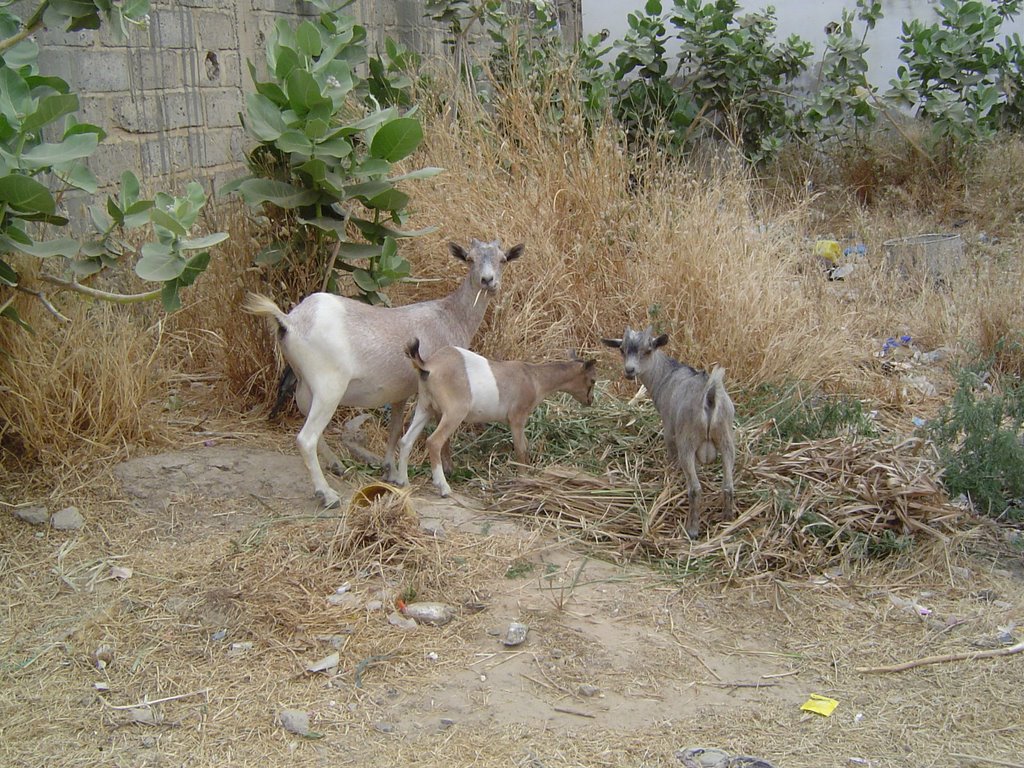
It’s the time of year where I post photos of (mostly dead and dieing) sheep online and people have already been calling them goats (I’m not sure if this is insulting for them… probably actually more insulting to the goats as I’ll describe). Plus I was watching an episode of the West Wing the other day on which a sheep was featured and they even called it a goat, so I wanted to clear up this sheep/goat mystery. In Senegal there are lots of both animals and truth be told, when I stepped off the plane I couldn’t tell the difference between Senegal’s short-haired sheep and the goats. When a goat is standing next to a sheep you will notice that the goat is quite a bit smaller, and it’s ears and tail are sticking up rather than down like the sheep’s. Sheep’s tails actually really gross me out. When not shortened, they are a little over a foot long but the sheep can only move the top quarter or so, so the rest of it ends up flopping around like a limb that has fallen asleep. The goat’s coat seems coarser and they come in many different colors where the sheep, even though you’ll see the occasional brown or black one, are nearly all white. Sheep have very spindly legs and goats look a little more sturdy, especially the little ones; kids love to frolic and climb and jump where as lambs stumble along looking like they might fall over at any moment (though both are cute). By sound, both can irritate the shit out of you, but goats sound eerily like people screaming. Sheep are loud and annoying but at least you know it’s an animal and not the neighbor kid getting beat up. Intelligence-wise, sheep are the dumbest animals in the barnyard, and even though I’ve had the urge to pick off goats like a sharpshooter because they are soooo irritating, they are relatively clever. So there you go, now you can have fun trying to “name that animal” when looking through my photos. 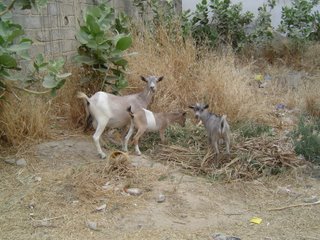
Here is a little family of goats, happy as can be, eating trash.
And here is a female sheep with her lamb, standing around being stupid.

Here is a little family of goats, happy as can be, eating trash.
And here is a female sheep with her lamb, standing around being stupid.
My trip with the guys
On December 12th, 2006 I got on a plane and left Senegal for the first time in over 14 months. My companions on this adventure were fellow PCVs from the Kaolack region; Arun, Paul and Shane and we were headed to sub-tropical West Africa; Togo and Ghana. The country we were leaving had not seen rain in 2.5 months and at least for the part North of the Gambia, was turning into a big sandy wasteland. In addition, on the 11th I had a major meltdown in the post office in Kaolack (something about them refusing to open any of the 15 huge bags of packages, one of which, I was sure, contained the watch I had been waiting on for months), it was time for Becca to take a short break from Senegal.
In true Senegalese style, our Air Senegal plane was running 2 hours late, but once we got on the plane we found a veritable feast of airline food unlike any domestic-travel American has seen in a decade. About 4 hours later we were landing in Lome, Togo with lush, green vegetation and a beautiful shoreline. We didn’t take our time in the airport, paid our 15,000 CFA (about $30) for our visas and got a cab to the garage to get public transport to Kpalime a small town in the mountains. The communication was fine because two of us speak French more than well enough to get around but I had a sense of impotence at having to use the colonial language, knowing how French-speakers are viewed here in Senegal, but alas, I speak no Ewe or Twi.
The couple days we spent in Togo at the beginning of our trip were filled with gawking at the greenness, the changing topography and the beautiful fruits and vegetables that they were able to grow in this sub-tropical climate – all very different from Senegal. We also did a little hiking, learned about some of the local plants, saw a local ‘moonshine’ operati on where men were taking the palm wine they harvested from trees, putting it through some process that involved barrels, rubber hoses and fire, and somehow a sort of palm liquor comes out the other end. This is also where we tasted our first fufu, the national dish of Togo, Ghana and possibly other countries in that region. Fufu is made by pounding cassava root or yam until it is paste-like, and then boiling it (I believe). It comes out as this tasteless, spongy blob of white material that really has a consistency unlike anything else I know, maybe kind of like cream of wheat that has been left out a while and is more solid?? Anyway, they put a stew over the fufu and it is eaten with the hand, even in restaurants. After tasting fufu a couple times, I’m somewhat glad that I didn’t have to endure it in a Togolese village for 2 years, though the environment sure would’ve been nice.
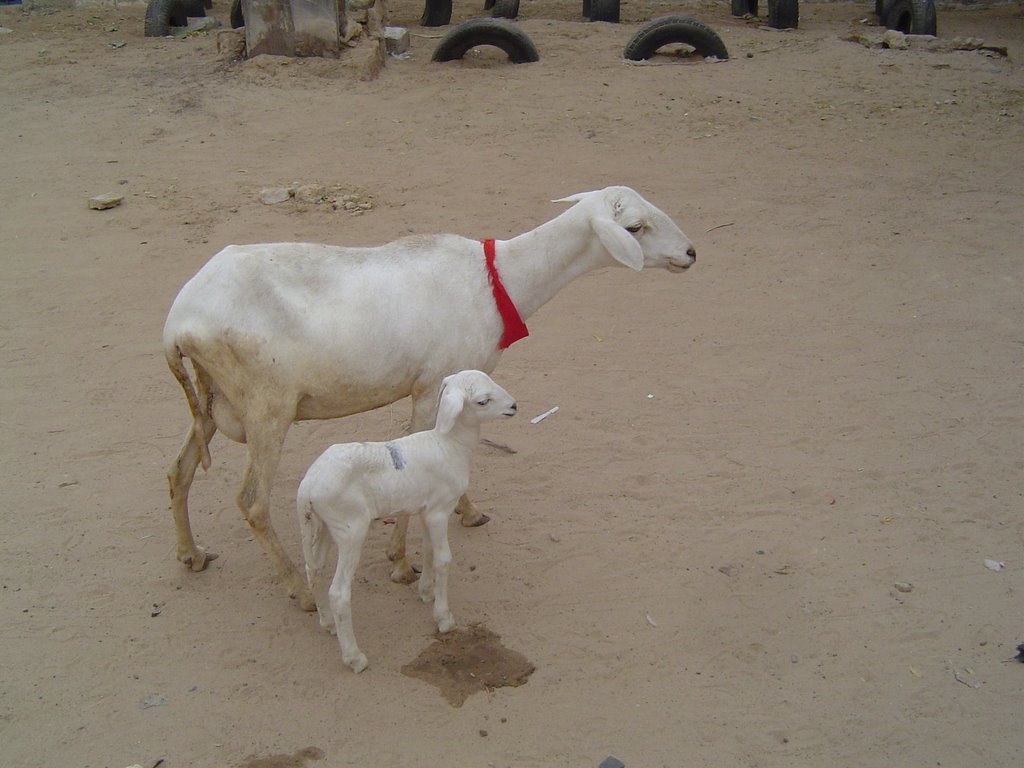
We crossed into Ghana on day 3 of our trip. At the last border stop in Togo, they told us that they couldn’t extend our one-week visa and that we would probably have to pay again to get back into Togo to catch our return flight. We weren’t thrilled at this news, but we were really excited to get to Ghana so we brushed it off. We waited at the border for a little while since the dude there told us that a bus was coming through soon. I’m pretty sure we were all imagining this bus being like the oversized, crowded vans that we had taken in Togo and take all around Senegal, especially by the looks of the scrappy little border village. To our surprise after about 45 minutes a brand new-looking full-sized city bus comes rolling down the dirt road. We took a slight detour but that afternoon ended up in Ho. Ho was a lovely little town and a great introduction to Ghana. Relatively clean and the city’s layout and architecture had an organization to it that reminded me of a more developed country. After the initial big differences, it was funny to note the small differences and similarities in the comparison I couldn’t help making between Ghana and Senegal. The gutters were extremely deep, so deep I  was kind of afraid for my whole stay that I was going to fall in. The shops, like in Senegal, were obviously named with heavy religious overtones. Unlike Senegal however, these store signs were Christian and in English; God’s Eye Photography, The Lord is My Shepherd General Store, Jesus is King Salon, etc. Because of the relative lack of Muslim influence, drinking of alcohol is MUCH more visible, a freedom that I’d say surely has its ups and downs for the community. It was at the restaurant in Ho that we saw they had cat on the menu. Shane attempted to order it but they said they were out, funny because there were plenty of cats running around under the tables while we were eating.
The following day we headed to Wli Falls, supposedly the highest waterfall in West Africa. After some finagling and writing and signing a disclaimer, we worked our way into camping right at the falls, something that seemed like a great idea at the time. The falls were definitely beautiful and we had fun with our little picnic dinner but we started regretting the decision to set up camp so close to the falls later than night; cold, damp and on the hard ground isn’t exactly the most 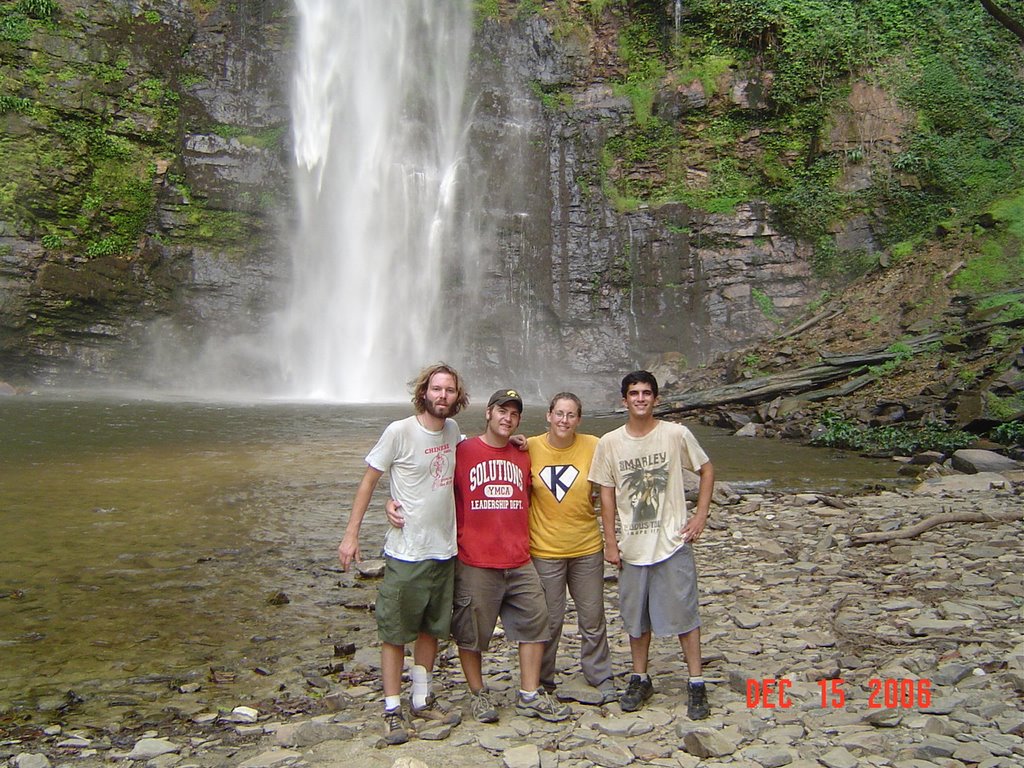 comfortable way to sleep. The next day we hiked up to the upper falls that we couldn’t even see from where we had camped. Our guide, Alfred, was in his mid-40’s, had a bad knee and was wearing flip-flops, yet he was able to prance right up the near vertical climb that nearly leveled Paul and myself. We had to take several breaks and Paul was certain he was going to throw up (though he never did), but as we got to the top and Alfred adjusted the ace bandage around his knee and lit up a smoke, we saw the upper falls up close and it was well worth the minor discomfort of getting there. The upper falls were very similar to the lower falls with the added thrill of being able to look down the 30-meter plunge of the lower falls from above. We caught our breath, took some pictures and headed back down to the sound of traditional, Ghanaian drumming coming from a celebration going on down at the lower falls.
For those of you that know me it’ll come as no surprise to find out that I took a digger that day. Thankfully I didn’t fall on the way up or down that very steep and very long hike, though I’m sure I stumbled more than once, no it was on relatively flat ground after packing up our things. I had my big pack on so not only did I fall but the weight of the bag kept going until my face was right in the dirt, I managed to roll over, turtle on it’s back style, and of course had to get unharnessed before I could actually stand up. Quite embarrassing and the guys didn’t let me forget it, but it makes for good stories, and a good tear in the knee of my pants.
Our next leg of the trip took us to Lake Volta, a huge lake that was formed when they dammed the Volta River in the 60’s. After waiting overnight since we were too late for the ferry that day we headed to the lake bright and early the next morning. We show up and there are folks washing their cars, people doing laundry and a couple pirogues (think large, wooden canoe), but no ferries. We soon found out that the ferry was busted and we’d have to take a pirogue, which ends up being faster than the ferry, great! 4 hours later we’re still waiting for a pirogue to fill up so we can leave. As soon as we threaten to get out and take a car to Accra, they stop us and say they’re ready to leave. The pirogue ride was pretty nice but when we got to the opposite shore there was one van for all the boats clientele and their luggage. We were crammed in like sardines, tighter than anything I’d experienced in Senegal, we were about to leave and that is when four, not skinny, not exactly pleasant or polite women shove themselves and their luggage into the van. At this point breathing is not the easiest both for lack of space and because deodorant isn’t all too common in this part of the world. This van took us to a small town where we caught a ride in a dude’s car to the ferry landing to cross another part of the lake. Holding on for dear life as the guy drove well above 100 km per hour, we got to the ferry right on time for a sunset ferry cruise. On the far shore we looked for a trotro(the van/bus thing that makes up most the public transport here), got in the middle of a fight between the two trotros that wanted to take us and finally got on our way to the final destination of the day, Kumasi. The road to Kumasi was quite exciting, especially at night with a combination of narrow, dirt roads paved highway. The road leading down from the mountains into the city itself was a steep, switchback road that was quite frightening but also quite beautiful from the top where we could see the lights of Ghana’s second biggest city splayed out before us.
Kumasi is the seat of the Asante Kingdom, a kingdom that spread over much o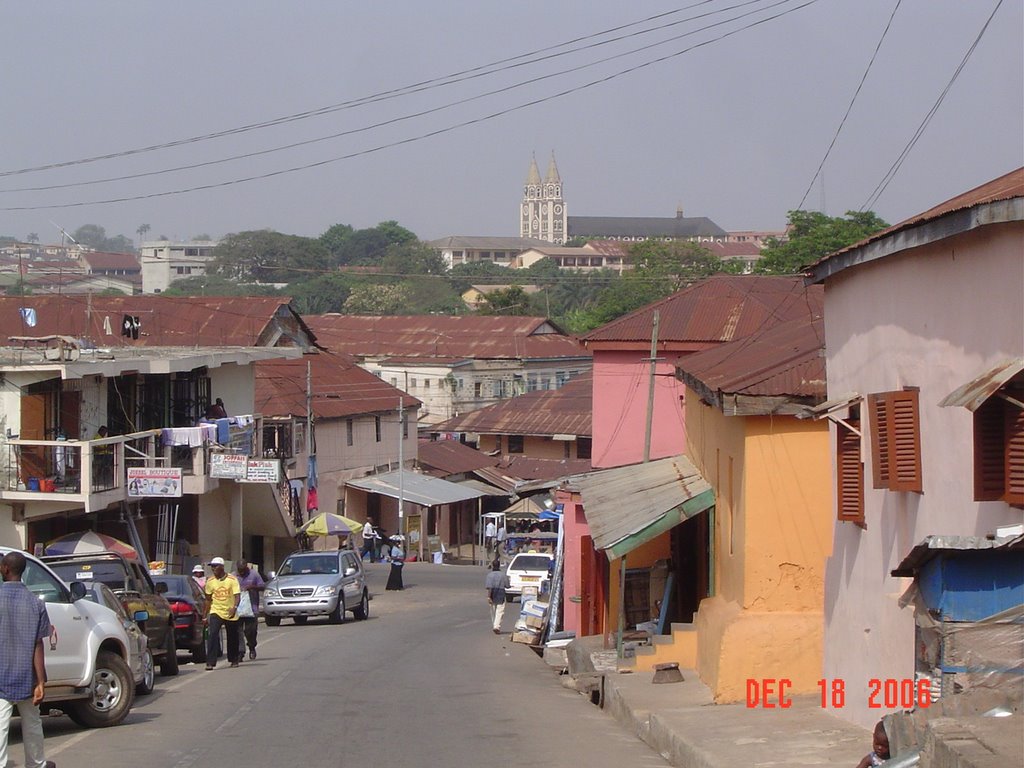 f the region and that was one of the few to have really fought and challenged the colonial powers in the early days of settlement. Kumasi was also unlike anything I had seen on the continent so far. With its beautiful, modern architecture and clean streets it almost looked more European than African. The royal family still lives in Kumasi, in a palace overlooking the city, with peacocks roaming the grounds. I took a tour and learned a lot about Asante history and culture including the sacred stool that is a sign of power throughout the region and the beautiful, woven kente cloth that is traditionally worn, 10 meters at a time, draped, toga style around the wearer.
That afternoon we met up with Peter Pipin, a friend and co-worker of our fellow PCV, Paula, from back in their days at the Smithsonian Museum of African Art. He treated us to lunch and wonderful conversation an d then we were off. We spent the night at a hotel overlooking a large crater lake and surrounded by tree-covered cliffs, then swung back through Kumasi on our way to Cape Coast. Outside Cape Coast we stayed at a place called Hans Boatel that was surrounded by a pond that is home to several alligators. Kitschy, the restaurant and bar was actually made up of little island-like gazebos on stilts. The guys had a little too much fun that night, involving lots of beer, a swimming pool and some Danish girls, so no one was really aching to do the canopy walk that had been planned for the day. Instead we stopped by one of the many slave castles that dot the Ghanaian coast. Very similar to what I had seen at Isle de Gorée in Senegal, there was a nice museum portion that actually included a display on prominent African-Americans.
Later that day we found ourselves at Big Milly’s, a backpacker’s haven that was by far the best place we stayed. Comfortable with delicious food and the beach right there at very decent prices, we ended up staying two nights to take full advantage of the beach and the hospitality.
The last three stops of the trip were all going to be large, West-African capitals; Accra (Ghana), Lome (Togo) and Dakar (Senegal). Accra is so big that the one night we spent didn’t really allow us to see much of it, but from what we did see it seemed nice. Like Dakar, there were lots of opportunities to eat our money with an upscale restaurant on every corner. Something we hadn’t seen elsewhere though was the entertainment we had. Attached to a Chinese restaurant is an operation where people can rent recent release DVDs, and small but comfortable air-conditioned rooms (with a leather couch and big screen tv) for a couple hours to watch the movie. It was Arun’s b-day so we let him pick out the movie. He decided on ‘Munich’ the new (to us) Spielberg movie. The movie, while not being something I’d pick out on my b-day, was really good and we topped off the night at a nice Indian restaurant for dinner.
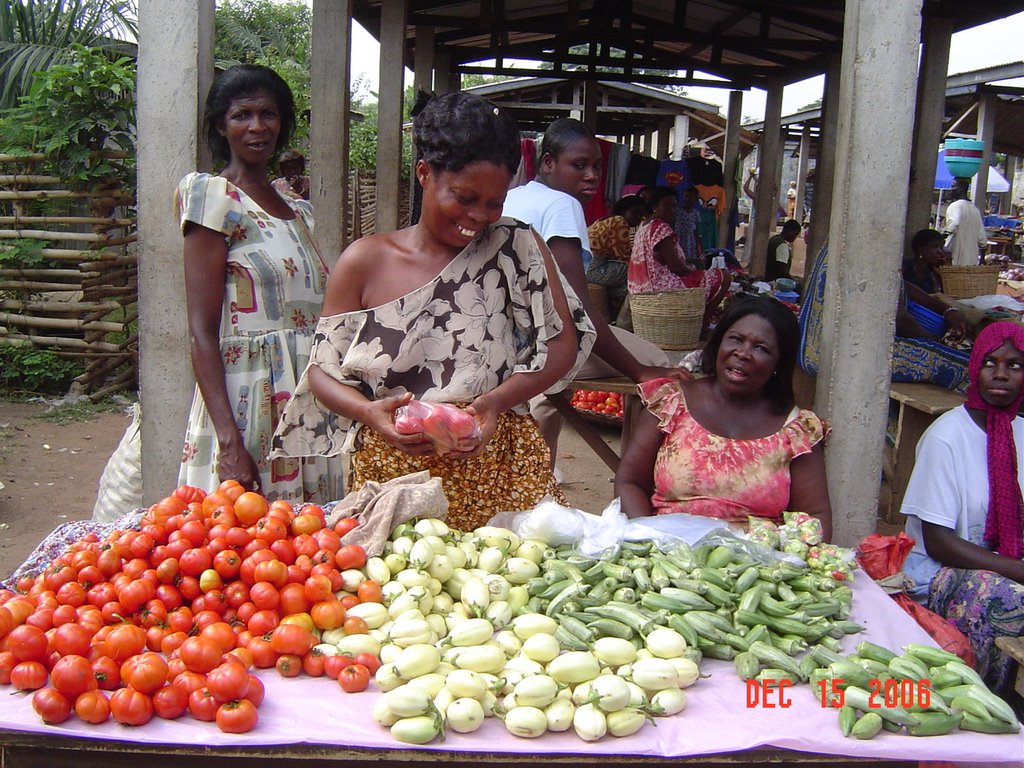
On Xmas Eve, after paying another 15.000 CFA for another visa for Togo, we were a little pissed off and back in Lome. We found a quaint hotel with attached restaurant a couple blocks from the beach and dropped our bags in their last non-Senegalese location for a while. We scoped out the beach – ferocious waves, the market – crowded, filthy and more like we were used to back ‘home.’ The market also contained more, delicious-looking produce than I’d ever seen. There was an entire section of the market that was filled with boxes and boxes; some stacked four high, filled with plump, beautiful tomatoes. None of us could imagine how most of them weren’t going to go to waste, there were so many. On my third trip to the beach to challenge myself to some body surfing it was Xmas day and we were able to witness the Togolese Xmas beach picnic. It was really cute to see families gathered together on blankets, eating and having fun, something that is difficult to imagine happening in Senegal. In our last days we treated ourselves to some great food including middle-eastern, French and Shane even ordered antelope (gamey but not too gamey). And on December 26, Boxing Day, we were back to Senegal, but not before buying some gag gifts for the boys and being asked if I was pregnant by some airline employee – thanks!
Senegal welcomed us back with an airport workers strike, helping the process to take twice as long as it should. I picked up the last of my gifts (the best gifts ever according to my host mother) at the airport duty free and it was back to life as a Peace Corps Volunteer.
Friday, December 08, 2006
Trash
I’m sure you’ve picked up on the fact that Senegal is not the most pristine, trash-free places in the world, and that Kaolack is one of the dirtier cities here. Well, I’ve come to terms with all that. The trash in the streets doesn’t even faze me anymore, though I still try not to contribute to it myself. What does faze me is when the trash that I do create gets up and walks around, on display for the whole neighborhood. My host family has a trash bin out front and a trash service that comes often to empty it. About once per month I empty my trash into the bin outside and wait. Within minutes the kids – mostly boys, have picked through it and found the coolest discarded razor or candy wrapper ever! I guess I have to admit that my trash, a lot of it originating in America, is a novelty for them but I almost feel like a patriot act victim having to censor my trash for fear of where it’ll end up. Village volunteers have it even worse because villagers are exposed to less and everything WILL end up in a kid’s mouth; wrappers, batteries, you name it. Because of this most village-based volunteers burn their trash because it’s just easier not to have to worry about it. But maybe I’m making too much of this, maybe trash is the next coolest toy and American kids will even catch on.
Some other volunteers are actually working on a solid waste disposal project at their site, it’s one of the biggest peace corps projects in Senegal right now. Doing research for the project one of them took a trip to Senegal’s largest landfill and came back with some interesting information. Even though there is no official recycling program in Senegal, probably about 98% non-organic solid waste gets recycled. This is possible because people seldom throw away something that can be reused but for the stuff that does get thrown out, there are people that scavenge through the trash at every step to find stuff they could clean up and sell. This includes plastic bottles, old shoes, anything glass… really everything except the organic stuff like food scraps (that also gets picked through by animals) and used batteries. The part that might be hard for westerners to get over is how this is done. People actually live in the landfill and to earn their living, pick through the trash and sell it to be reused. I can’t help but think that this unofficial recycling program works much better than the official ones in place in the US.
Some other volunteers are actually working on a solid waste disposal project at their site, it’s one of the biggest peace corps projects in Senegal right now. Doing research for the project one of them took a trip to Senegal’s largest landfill and came back with some interesting information. Even though there is no official recycling program in Senegal, probably about 98% non-organic solid waste gets recycled. This is possible because people seldom throw away something that can be reused but for the stuff that does get thrown out, there are people that scavenge through the trash at every step to find stuff they could clean up and sell. This includes plastic bottles, old shoes, anything glass… really everything except the organic stuff like food scraps (that also gets picked through by animals) and used batteries. The part that might be hard for westerners to get over is how this is done. People actually live in the landfill and to earn their living, pick through the trash and sell it to be reused. I can’t help but think that this unofficial recycling program works much better than the official ones in place in the US.
Tie a yellow ribbon ‘round the Acacia
Last week there was a pretty major homecoming in my neighborhood; Taffa, the husband of the young woman who lives next door, Astou Diop, came back from Sudan. Taffa is in the Senegalese military and was serving in Darfur as part of the African Union peace-keeping efforts, he was there for 9 months. Astou and Taffa have two young sons, Ndieye Seck; who was born only a month before Taffa left and Momar who is 3. I haven’t actually taken part in military homecomings in the US but from what I’ve seen on tv they are quite emotional; embracing, tears, sometimes screaming, as I would expect after a long absence of someone you love. Taffa was in one of the more war-torn, presumably dangerous places in the world, he was gone for nine months and the reaction he got from the family when he showed up was nearly indistinguishable from the greeting I get when I get back from a 4 day trip to Dakar. There was no embracing, no tears only smiles and little chanting from the kids, ‘Taffa Sene came back! Taffa Sene came back!’ And that excitement really could’ve been mostly in anticipation of the gifts he had brought back.
It is Senegalese custom to bring a gift for the family when you come back from any trip. This gift could be as little as a piece of fruit or candy for each member of the family. Taffa apparently had lots of fun using the large sum of money the Senegalese government handed him as he got off the plane. As soon as he set foot out of the car he was showering his family (the poorest one in the neighborhood) with gifts. A bike for Momar, baby toys for Ndieye Seck, loads of brand new clothes for the boys, gold jewelry and expensive woven fabric for Astou Diop, a big, thick blanket for his mother-in-law, Umi Dia, and a bunch of new toys for himself. I’ve been helping Taffa’s nephew, Sylla, for the past few months to save his money, CFA by CFA, to teach him how to save up for things he wants and needs to buy. Sylla is doing a great job and has managed to buy some shorts that he had wanted. I sincerely hope that Sylla doesn’t get any ideas from Taffa, at the rate he’s going Taffa will be out of money relatively soon and the family will be struggling to get by once again. There really isn’t much I could do or say to Taffa to help either, being younger than him and female, advice wouldn’t do much coming from me.
It is Senegalese custom to bring a gift for the family when you come back from any trip. This gift could be as little as a piece of fruit or candy for each member of the family. Taffa apparently had lots of fun using the large sum of money the Senegalese government handed him as he got off the plane. As soon as he set foot out of the car he was showering his family (the poorest one in the neighborhood) with gifts. A bike for Momar, baby toys for Ndieye Seck, loads of brand new clothes for the boys, gold jewelry and expensive woven fabric for Astou Diop, a big, thick blanket for his mother-in-law, Umi Dia, and a bunch of new toys for himself. I’ve been helping Taffa’s nephew, Sylla, for the past few months to save his money, CFA by CFA, to teach him how to save up for things he wants and needs to buy. Sylla is doing a great job and has managed to buy some shorts that he had wanted. I sincerely hope that Sylla doesn’t get any ideas from Taffa, at the rate he’s going Taffa will be out of money relatively soon and the family will be struggling to get by once again. There really isn’t much I could do or say to Taffa to help either, being younger than him and female, advice wouldn’t do much coming from me.
Tuesday, November 14, 2006
Things I haven't done in over a year
- Seen friends and family
- Hugged anyone I've known for most my life
- Snuggled with a cat
- Seen snow
- Seen mountains
- Swing danced with a partner :'(
- Left Senegal
- Saved handshakes for formal occasions
- Gone a day only speaking English
- Attended a game brunch :'(
- Driven a car
- Driven a scooter
- Used a dish washer
- Used a washing machine
- Used a vacuum cleaner
- Gotten a professional hair cut
- Spoken with some friends and family
- Ridden in an airplane
- gone a week without eating rice
Eating and drinking section
- good beer
- brats
- Chinese food
- Thai food
- Wisconsin cheese
- deli food
- diner food
- edible corn on the cob
- cheese steak
- mom's banana chocolate chip pancakes
- tofu
- spinach borsht
- fresh berries
- artichokes
- salmon
- Hugged anyone I've known for most my life
- Snuggled with a cat
- Seen snow
- Seen mountains
- Swing danced with a partner :'(
- Left Senegal
- Saved handshakes for formal occasions
- Gone a day only speaking English
- Attended a game brunch :'(
- Driven a car
- Driven a scooter
- Used a dish washer
- Used a washing machine
- Used a vacuum cleaner
- Gotten a professional hair cut
- Spoken with some friends and family
- Ridden in an airplane
- gone a week without eating rice
Eating and drinking section
- good beer
- brats
- Chinese food
- Thai food
- Wisconsin cheese
- deli food
- diner food
- edible corn on the cob
- cheese steak
- mom's banana chocolate chip pancakes
- tofu
- spinach borsht
- fresh berries
- artichokes
- salmon
Dazed and Confused...
Before lunch today I spent a good couple hours looking at myspace. I'm in Dakar for the week so the lure of free internet at the office proves to be too much to bare at times. I was glancing at my sisters' pages and then I noticed that my high school had a group there so I did a little searching for classmates. Finding a few it was pretty cool to see how people were doing, especially since I'll likely be missing my 10-year reunion next year. Yes people have real jobs, yes people have gotten married and yes people have kids (yikes!!). Anyway, this whole thing reminded me of this phenomenon that my friends and I experience after the slightest exposure to the world we used to live in. After the myspace surfing, remembering the good ole days at MHS, I stumbled out into the crowded, hot, filthy streets of Dakar for some lunch of rice and meat, and experienced a minor culture shock attack. This happens just about any time I use the internet, watch satellite tv or just about anything else that is able to transport my mind back to the simpler time in my life. The physical change of going from a room that is usually a little dark, quiet and cooler thanks to fans (or if you're lucky AC) to the bright, loud, blazing hot Senegalese street - paired with the mental adaptation that has to occur can sometimes throw off even the best acclimated ex-pats.
Monday, November 13, 2006
Absentee Voting
Last week, just like millions of other Americans, I voted. Now voting, no matter how exciting or maddening the elections or results may be, is kind of a mundane process. Mine differed some from the typical so I thought I'd share it.
Back in August I contacted the Town of Middleton (referred to as ToM from here on out) by email to request an application for an absentee ballot, being sure to leave plenty of time before elections. I downloaded and filled out the application, following the instructions very carefully, because I know one little slip could very well negated the entire application. I mailed the request in and began to wait. Next thing I know Mid-October is rolling around and I haven't heard a thing from ToM. I am allowed to mail the ballot itself in as long as it is postmarked on or before the date of the election, because the State of Wisconsin lumps Peace Corps together with Military (exactly what no one in Peace Corps wants) so I wasn't quite freaking out yet. I decided to send another email to inquire. I get an email back saying that I did something wrong on my request and that a letter of explanation and another absentee ballot request form had been mailed to me over a month ago. Now, why someone would go to the trouble to mail something to me that could've much more easily been emailed and downloaded, I am not sure, especially when it was mailed to a developing country with a postal system that is iffy at best. So I start racing to download another request and reading through the directions again to figure out what I did wrong. According to the instructions, I did nothing wrong. I write this back to ToM and they say that they have, against their better judgment, put a ballot in the mail for me, with two weeks to go till the election. The next day I went to the post and found the envelope in my boite postale from ToM. It had taken over a month to get to me, which is not uncommon here, usually stuff gets to Dakar in a timely manner but then takes quite a while to get from Dakar to the smaller cities and towns. However, after examining a little closer I found out exactly why it had taken so long, ToM had put a 39 cent stamp on a letter to go over seas. It really shouldn't have gotten here at all and was probably put on a barge to get here.
So I sat and waited for my ballot to show up, thinking it may very well take over a month like the first thing, especially if they put another 39 cent stamp on it. In true Senegal fashion, thought, the ballot showed up in my box on Tuesday. So I wormed my way into using the internet at the Post to check out the candidates. After I finished voting I filled out the envelope, which has my name and address where the recipient's info typically goes on an envelope and took it to the window to get it stamped. Every time I have to wait in line, almost anywhere, this is what happens; I get in line, where the apparent end is, as soon as the person at the front is done, at least two people race to see who can get their letter to the dude first, often someone will walk into the room and right up to the front of the line, cutting in front of everyone. This is something that, even though I still don't understand the process, I have learned to be patient about. After a very loud tantrum I threw in the bank I realized that it's better to just be patient.
Anyway, once I get to the front of the line, after a young guy and and older lady cut right in front of me, the dude tells me that the layout of the envelope is going to confuse the mail carriers in Senegal and it won't get where it needs to go. So I go buy another envelope, take the inner one to get stamped with the date just in case and get back in line, only to be cut in front of twice more while waiting for the stamp guy. Finally the process is finished as I seal the outer envelope and drop it into the box. Whole process that day took about 3 hours.
All that work and Wisconsin still managed to make sure that outright discrimination is a part of our State constitution. Really kind of maddening, but as they say here, 'patientez' - be patient, they'll come around.
Back in August I contacted the Town of Middleton (referred to as ToM from here on out) by email to request an application for an absentee ballot, being sure to leave plenty of time before elections. I downloaded and filled out the application, following the instructions very carefully, because I know one little slip could very well negated the entire application. I mailed the request in and began to wait. Next thing I know Mid-October is rolling around and I haven't heard a thing from ToM. I am allowed to mail the ballot itself in as long as it is postmarked on or before the date of the election, because the State of Wisconsin lumps Peace Corps together with Military (exactly what no one in Peace Corps wants) so I wasn't quite freaking out yet. I decided to send another email to inquire. I get an email back saying that I did something wrong on my request and that a letter of explanation and another absentee ballot request form had been mailed to me over a month ago. Now, why someone would go to the trouble to mail something to me that could've much more easily been emailed and downloaded, I am not sure, especially when it was mailed to a developing country with a postal system that is iffy at best. So I start racing to download another request and reading through the directions again to figure out what I did wrong. According to the instructions, I did nothing wrong. I write this back to ToM and they say that they have, against their better judgment, put a ballot in the mail for me, with two weeks to go till the election. The next day I went to the post and found the envelope in my boite postale from ToM. It had taken over a month to get to me, which is not uncommon here, usually stuff gets to Dakar in a timely manner but then takes quite a while to get from Dakar to the smaller cities and towns. However, after examining a little closer I found out exactly why it had taken so long, ToM had put a 39 cent stamp on a letter to go over seas. It really shouldn't have gotten here at all and was probably put on a barge to get here.
So I sat and waited for my ballot to show up, thinking it may very well take over a month like the first thing, especially if they put another 39 cent stamp on it. In true Senegal fashion, thought, the ballot showed up in my box on Tuesday. So I wormed my way into using the internet at the Post to check out the candidates. After I finished voting I filled out the envelope, which has my name and address where the recipient's info typically goes on an envelope and took it to the window to get it stamped. Every time I have to wait in line, almost anywhere, this is what happens; I get in line, where the apparent end is, as soon as the person at the front is done, at least two people race to see who can get their letter to the dude first, often someone will walk into the room and right up to the front of the line, cutting in front of everyone. This is something that, even though I still don't understand the process, I have learned to be patient about. After a very loud tantrum I threw in the bank I realized that it's better to just be patient.
Anyway, once I get to the front of the line, after a young guy and and older lady cut right in front of me, the dude tells me that the layout of the envelope is going to confuse the mail carriers in Senegal and it won't get where it needs to go. So I go buy another envelope, take the inner one to get stamped with the date just in case and get back in line, only to be cut in front of twice more while waiting for the stamp guy. Finally the process is finished as I seal the outer envelope and drop it into the box. Whole process that day took about 3 hours.
All that work and Wisconsin still managed to make sure that outright discrimination is a part of our State constitution. Really kind of maddening, but as they say here, 'patientez' - be patient, they'll come around.
Wednesday, November 01, 2006
Alhamdoulilah!!!
I have witnessed a miracle. My camera was clinically dead for a couple weeks, the light would go on when I attempted to charge it but it wouldn't turn on at anytime. I returned home last Sunday to make a last ditch attempt to revive it, thanks to some info from my mom. I picked it up, hit the power button, and.... tah dah! We had power!! I think it knew I was threatening it with burrial in the disgusting trash pits on the outskirts of town and it decided to shape up, but who knows, it could've been Yallah.
Friday, October 27, 2006
RIP Sony Handishot
Well, I've got some bad news. You know those photos that I've been posting on my photo site? The ones that give you some more insite into life here? 1 Picture's worth 1000 words, yada yada. Well, unless there is some miracle of technology about to occur right here in Kaolack, there will be no more. That's right, Senegal has dealt a final blow to my digital camera and murdered it. It was a long fight with the sandy winds and the extremely humid rainy season, my poor little camera was no match for the harsh conditions of the Sahel region of Africa. The funeral will be this Sunday at the trash heap in Kaloack. Now you may be asking which trash heap, there are so many in Kaolack...it'll be the trash heap off the road to Diorbel. Please bring your kind words and fond memories of an electronic life that was cut tragically short.
Thank you.
Thank you.
It's begining to feel a lot like...
The last time I spoke with my parents they told me that it had snowed in Wisconsin already. Last year I almost burst into tears when I heard about or saw photos of snow, this year is better. But the most exciting news is that I actually had to use my thin fleece blanket along with a sheet to sleep last night. Granted, both my windows were open but it was the best sleeping weather we've had in months and its a sign that 'the cool season' is on its way. By cool season I mean that it probably gets down 70° at the coolest at night and still gets up in the mid 90s during the day, but believe me, it is a refreshing break.
Enjoy your snow and I'll enjoy my thin-blood 'cool' weather.
Enjoy your snow and I'll enjoy my thin-blood 'cool' weather.
Sunday, October 22, 2006
Ramadan #2
Today is the last day of my second Ramadan in Senegal. Last year I only fasted during Yom Kippur but this time around I got about 6 days in besides Yom Kippur. The idea behind Ramadan if I’m not mistaken is to atone for sins, be extra giving to those who are in need and to experience life as it is for those people who are truly in need. This is done through fasting during daylight hours for 30 days. Since Ramadan is a month in the Muslim calendar (a lunar calendar), it rotates throughout the year. This means that Ramadan is about 10 days earlier each year. This year it has fallen during both the harvest and the most miserable (hot and humid) month of the year. Villagers are fasting while they do the hardest work of the year at the hottest time of the year and I can’t help but think that these are the people most other Muslims think of when they give up food and water for the month to live closer to poverty. I can almost here the explanation that a Muslim-American mother might give her son for the sacrifices they make – “Just think about the Muslims in Africa who don’t have enough food to eat.” Yet, those Africans who don’t have enough money to eat much besides a bit of plain rice normally, are themselves sacrificing. Who do they think about when they try to make their lives closer to poverty for the month? And if they don’t really see themselves normally as impoverished, who really are the poor? From the villages I have been to I would say that the people are aware of their lack of material possessions and money, but they tend to have enough to get by and more importantly, everyone has family and that is what is really important. I haven’t asked anyone, but I would guess that the villagers imagine someone with no family, an orphan, when they think about the truly poor.
AFN
I should probably think twice before publishing this on the internet but it was one of those eye-opening experiences that I just have to share. I was recently somewhere where I saw for the first time AFN, Armed Forces Network. I guess this is the satellite tv that all overseas employees of the US government get. We were just watching some good ole American football, but what came during the commercial breaks made me shiver. Each ‘commercial’ was full of propaganda and paranoia and was obviously meant more for military than anyone else. The one that stuck in my mind was the friendly reminder of Article 88, that states that it is illegal for members of the military to speak ill of the president, vice-president or any member of the senate or congress. In my position, I’m not allowed to stage any sort of governmental rally but my everyday freedom of speech is left intact. For military though, where does the freedom of speech leave off and Article 88 take over?
Article 88
“Any commissioned officer who uses contemptuous words against the President, the Vice President, Congress, the Secretary of Defense, the Secretary of a military department, the Secretary of Transportation, or the Governor or legislature of any State, Territory, Commonwealth, or possession in which he is on duty or present shall be punished as a court-martial may direct.”
Article 88
“Any commissioned officer who uses contemptuous words against the President, the Vice President, Congress, the Secretary of Defense, the Secretary of a military department, the Secretary of Transportation, or the Governor or legislature of any State, Territory, Commonwealth, or possession in which he is on duty or present shall be punished as a court-martial may direct.”
Wednesday, October 11, 2006
High Holy Days in a Muslim Country
Hey everyone,
The holidays of Rosh Hashanah, Yom Kippur and Ramadan have either recently happened or are still going on. For Rosh Hashanah I set up a little ceremony with my host family and friends complete with challah, apples and honey. For Yom Kippur I went to Tambacounda to celebrate with other Jewih PCVs, I wrote an article about it for the Peace Corps Senegal newsletter, it's pasted below. For Ramadan I was under the weather when it started but I am in my second day of fasting out of solidarity, the thirst is definitely the hardest part. I'll post more on Ramadan here soon. Cheers, Becca
New Jewish Traditions in a Muslim Country
By Becca Schwartz
The Jewish High Holidays of Rosh Hashanah and Yom Kippur were recently celebrated in homes and synagogues across the diaspora. Though its not quite as easy, as there aren’t any synagogues in the country and chances are the only torah in Senegal belongs to the folks at the Israeli Embassy, with a little creativity and initiative, Jewish PCVs are able to observe holidays here in Senegal. A short time ago, with the help of a couple prayer books, a few trips to the cyber café and the coming together of several families’ traditions, Jewish PCVs gathered for Yom Kippur in Tambacounda.
Yom Kippur is the holiday where Jews attone for sins they have comitted in the past year, it is a time of repentance, forgiveness and fasting, similar to the Muslim hoilday of Ramadan. By chance, the Holy months of Ramadan and Tishrei (the Jewish month in which Rosh Hashanah and Yom Kippur fall) intersected this year. This overlap happens three years in a row, every 30 years so Jewish PCVs currently serving in Muslim countries have an opportunity for a special cultural exchange and interesting discussion.
Yom Kippur in the Tamba house turned out to be an interesting mix of joyful and solemn. Solemn because of the gravity of the holiday, thinking about what we had done wrong in the past year, promises we had broken and people we had hurt. It was a joyful time because of the community within the greater PCV community that was being formed. We were coming together to celebrate our common faith, culture and heritage. When we weren’t fasting we found joy in eating delicious, traditional Jewish foods. There is also a joyful optimism found in planning to be a better person in the coming year.
In Judaism, discussion about how the ancient prayers, traditions and laws pertain to our modern lives is important. We talked about the act of apologizing to someone we had wronged, forgiveness, the recent Israel-Lebanon war as well as the volatile relationship Muslims and Jews have had. As the sun dropped slowly toward the horizon, we took time to remember those lives that had been lost in the past year.
As the 26 hours of fasting came to an end, we decided to take our celebration onto the roof so we could see the first three stars in the evening’s sky that mark the end of our fast. One last opportunity was taken to atone for the sins we had committed against our communities, the earth, ourselves and God, before the fast was broken. During the meal of matzoh ball soup, latkes(potato pancakes), stir-fried okra and challah(braided bread) that followed, there was a real sense of closeness, of community and that wonderful feeling that maybe we had started a new tradition for future PCVs in Senegal.
The holidays of Rosh Hashanah, Yom Kippur and Ramadan have either recently happened or are still going on. For Rosh Hashanah I set up a little ceremony with my host family and friends complete with challah, apples and honey. For Yom Kippur I went to Tambacounda to celebrate with other Jewih PCVs, I wrote an article about it for the Peace Corps Senegal newsletter, it's pasted below. For Ramadan I was under the weather when it started but I am in my second day of fasting out of solidarity, the thirst is definitely the hardest part. I'll post more on Ramadan here soon. Cheers, Becca
New Jewish Traditions in a Muslim Country
By Becca Schwartz
The Jewish High Holidays of Rosh Hashanah and Yom Kippur were recently celebrated in homes and synagogues across the diaspora. Though its not quite as easy, as there aren’t any synagogues in the country and chances are the only torah in Senegal belongs to the folks at the Israeli Embassy, with a little creativity and initiative, Jewish PCVs are able to observe holidays here in Senegal. A short time ago, with the help of a couple prayer books, a few trips to the cyber café and the coming together of several families’ traditions, Jewish PCVs gathered for Yom Kippur in Tambacounda.
Yom Kippur is the holiday where Jews attone for sins they have comitted in the past year, it is a time of repentance, forgiveness and fasting, similar to the Muslim hoilday of Ramadan. By chance, the Holy months of Ramadan and Tishrei (the Jewish month in which Rosh Hashanah and Yom Kippur fall) intersected this year. This overlap happens three years in a row, every 30 years so Jewish PCVs currently serving in Muslim countries have an opportunity for a special cultural exchange and interesting discussion.
Yom Kippur in the Tamba house turned out to be an interesting mix of joyful and solemn. Solemn because of the gravity of the holiday, thinking about what we had done wrong in the past year, promises we had broken and people we had hurt. It was a joyful time because of the community within the greater PCV community that was being formed. We were coming together to celebrate our common faith, culture and heritage. When we weren’t fasting we found joy in eating delicious, traditional Jewish foods. There is also a joyful optimism found in planning to be a better person in the coming year.
In Judaism, discussion about how the ancient prayers, traditions and laws pertain to our modern lives is important. We talked about the act of apologizing to someone we had wronged, forgiveness, the recent Israel-Lebanon war as well as the volatile relationship Muslims and Jews have had. As the sun dropped slowly toward the horizon, we took time to remember those lives that had been lost in the past year.
As the 26 hours of fasting came to an end, we decided to take our celebration onto the roof so we could see the first three stars in the evening’s sky that mark the end of our fast. One last opportunity was taken to atone for the sins we had committed against our communities, the earth, ourselves and God, before the fast was broken. During the meal of matzoh ball soup, latkes(potato pancakes), stir-fried okra and challah(braided bread) that followed, there was a real sense of closeness, of community and that wonderful feeling that maybe we had started a new tradition for future PCVs in Senegal.
Subscribe to:
Posts (Atom)